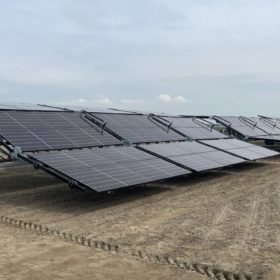
Mobile agrivoltaic system from the Netherlands
Created by a Dutch group of companies and research institutions, the mobile solar system may also be combined with an electrolyzer for hydrogen generation. Two prototypes are currently being tested by a farmer and a research institute in the Netherlands.
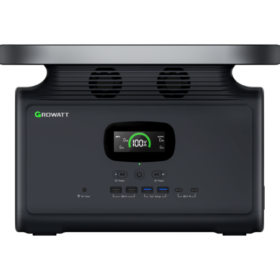
Growatt unveils solar rechargeable portable power station
Chinese inverter maker Growatt has launched Infinity 1500, a portable power station for off-grid applications.
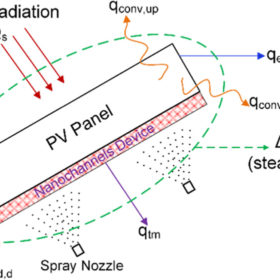
New solar module cooling tech based on porous nanochannels
US scientists have utilized a nanochannels device to cool down the operating temperature of a commercial PV module and have found that the proposed technique is able to improve power yield by up to 32.8%. Spray droplets are dispersed over the nanochannels device in order to eliminate the need for a continuous supply of a coolant.
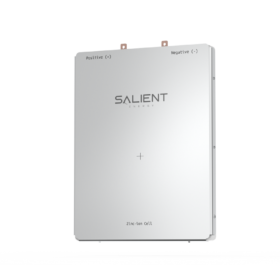
Zinc-ion battery for residential applications
Developed by Canadian start-up Salient Energy, the zinc-ion battery has a rated capacity of 60 Ah, a nominal voltage of 1.3 V, and a volumetric energy density of 100 Wh/L. The device measures 26cmx24cmx1.2cm and weighs in at 1.3 kg
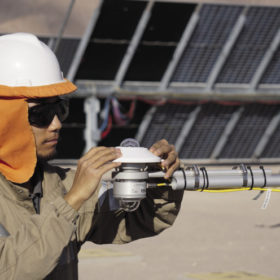
The long read: Defining the performance of bifacial solar modules
or some developers of ground-mounted PV, bifacial modules are already the default technology. The slight cost increase is often outweighed by an increase in energy yield. And yet “agreeing” on the right energy yield of a PV plant has always been the most heated debate between developers, investors, lenders, and technical advisers. Everoze partner Christophe Campistron looks at both sides.

Natural hydrogen – how it works and why companies are interested
Natural hydrogen is piquing interest. Sometimes referred to as “gold” or “white” hydrogen, natural hydrogen plants offer smaller carbon footprints than sprawling green hydrogen projects, with faster development times, according to Avon McIntyre, executive director of HyTerra.
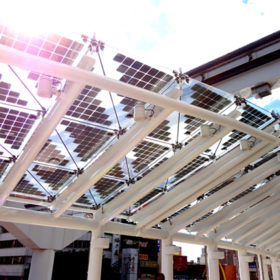
Glass-integrated BIPV module from Japan
Japanese glass manufacturer AGC has developed a building-integrated PV (BIPV) panel for different building requirements. It can be installed on facades, canopies, and curtain walls where normal glass can be placed.
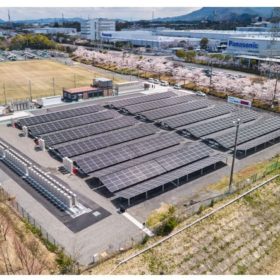
Panasonic combines fuel cells, batteries, PV to power factory in Japan
Japan’s Panasonic claims its new pilot solar-plus-hydrogen facility marks the first attempt to create a factory powered by 100% renewables, via the full-scale use of hydrogen.

Lithium battery recycling in India
Nitin Gupta, chief executive officer and co-founder, Attero Recycling, speaks to pv magazine about the supply chain concerns for lithium battery storage manufacturing in India, current battery recycling scenario and Attero’s capacity.
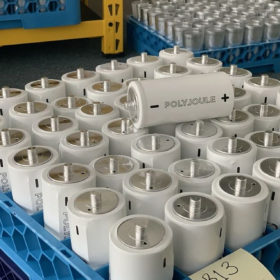
US start-up develops polymer-based batteries for stationary storage
Developed by an MIT spin-off, the device is based on a standard, two-electrode electrochemical cell containing conductive polymers, a carbon-graphene hybrid, and a non-flammable liquid electrolyte. The battery cells were tested to perform for 12,000 cycles at 100% depth of discharge.