Imec, Jolywood announce 23.2% front-side conversion efficiency for n-PERT bifacial cell
The result was certified by the solar cells laboratory at the calibration and test center of Germany’s Institute for Solar Energy Research. Imec’s measurements showed cell bifaciality surpassed 80%.
India takes to solar-powered desalination
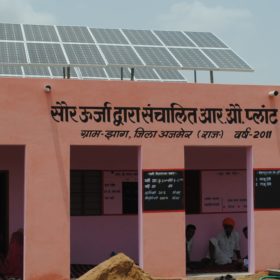
A 10,000-liters-per-day plant in Tamil Nadu offers hope for powering clean water without fossil fuels. However, researchers warn the technology is difficult to scale up because PV panels take up so much space.
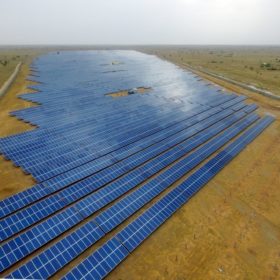
NHPC tenders 40 MW solar project in Odisha
National Hydroelectric Power Corporation (NHPC) has invited online bids for development of 40 MW grid-connected crystalline PV solar power project in District Ganjam of Odisha. The project will be awarded through domestic competitive bidding followed by reverse action.
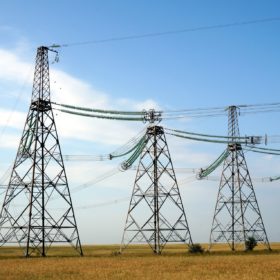
Market-based economic dispatch, a structural change with mixed outcomes: India Ratings
Market-based scheduling will enable flexibility in grids to facilitate renewable energy generation. However, the framework proposed by Central Electricity Regulatory Commission (CERC) doesn’t indicate any change in the payments mechanism for renewable projects, says the ratings agency.
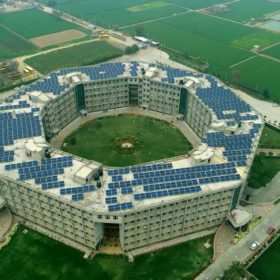
Akal University’s 1.2 MW solar project is Punjab’s largest for rural institutions
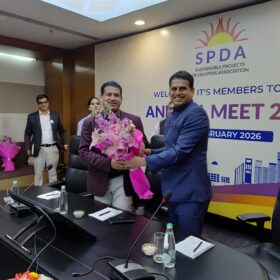
This 1.2 MWp project would generate more than 80% of power requirements of the Akal University and 13 Akal Academies. It has been built at a total cost of Rs 5.2 crore, out of which the Ministry of New and Renewable Energy has provided a total subsidy of around Rs 1.7 crore.
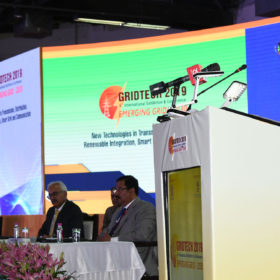
Vice President Naidu stresses on solar cities, smart grids, and EVs
India needs to adopt renewable energy and electric vehicles in a big way to meet the twin goals of energy security and climate protection.

Innovation boosts Lithium-ion battery recycling rate to over 80%
Finnish clean-energy company Fortum has achieved the Lithium-ion battery recycling rate of over 80%—as against the current 50%—with a low-CO2 hydrometallurgical recycling process.
Revisit forecasting and scheduling regulations for renewable power generation: NSEFI to MERC
To enhance the effectiveness of settlement mechanism, the National Solar Energy Federation of India (NSEFI) has asked the Maharashtra Electricity Regulatory Commission (MERC) to allow aggregation of generation schedule based on independent power producer or quality coordinating agency and considering the same for calculation of deviation. Removal of the rescheduling charges and dual payment mechanism are among other changes sought.

The long read: Human vs. machine
Some manufacturers have started to bring self-learning algorithms and artificial intelligence into their monitoring systems and have indicated this in our market overview. In this way, they seek to reduce the personnel costs of O&M service providers. Although humans still have the upper hand in many processes, artificial intelligence is on the rise.

Trina Solar rolls out four new series of modules
The high efficiency series can be used in multiple application scenarios like utility-scale ground-mount and distributed PV projects. An increase in the output of modules from 370W to 415W will help reduce the balance-of-system cost by 4.5% to 8.5%, and reduce levelized cost of electricity (LCoE) by 2.5% to 4.6%.