GST leads to 12% increase in solar project costs – AISIA
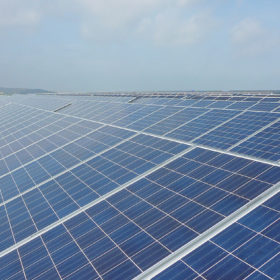
All India Solar Industries Association (AISIA) has urged the government to remove the Goods and Services Tax (GST) from the balance of systems for solar equipment. The association said that components like inverters, cables and transformers under GST are charged at 5-8%. Previously, they were charged 2% central sales tax and no excise duty.
Indian solar policy roundup 2017
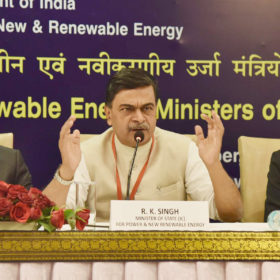
MNRE head RK Singh delivers a lowdown on India’s current solar installations, recent policies that the government has initiated, and the customs issues with imported solar modules.
ReNew Power mulls purchase of Waaree Energies solar portfolio – reports
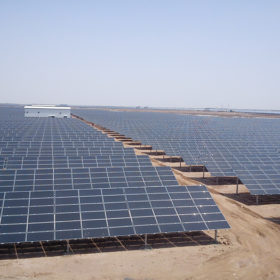
ReNew Power Ventures, which is backed by Goldman Sachs, is exploring an opportunity to acquire the solar assets of Waaree Energies ahead of a planned IPO, reports Mint.
Waaree Energies raises INR 1bn through Centrum-led investors
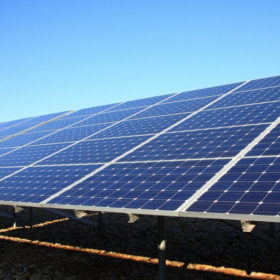
A structured credit deal has been struck between Centrum-led investors and Waaree Energies Ltd, an Indian solar power firm.
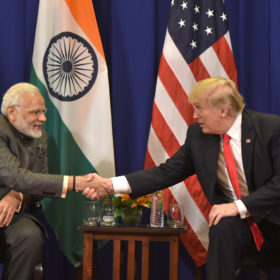
US to drag India back into WTO solar wrangle
Reuters reports that the United States is once again planning to take India back to a WTO ruling regarding an ongoing solar power dispute. Last year India lost the case against the U.S., which had alleged discriminatory practices in favor of domestic firms and against foreign competitors.
EIB partners with YES Bank to offer $400m funding boost to Indian renewables
Both the European Investment Bank and India’s YES Bank will provide $200 million investment to co-finance a series of solar and wind power projects across India.
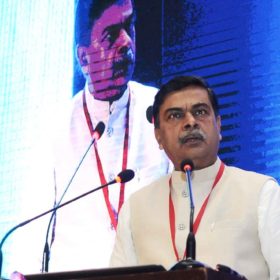
India electrifies over 15,000 villages in last three years – MNRE
MNRE head, RK Singh says 15,183 Indian villages have been electrified, out of 18,452, as of November 30. Free electricity connections have also been granted to 44.41 lakh below poverty line (BPL) households under the government’s rural electrification scheme.

Stable outlook for Indian power sector – Moody’s
Moody’s Investor Services and its Indian affiliate, ICRA Limited have announced that India’s power sector will see stability over the next 12 to 18 months, reflecting the government’s policy initiatives and established industry.

Apparel industry adopting solar energy in India
The ‘Adoption of Solar Energy for Apparel industry’ program was organized by cluster development services in Ludhiana, Punjab to promote solar in the textile/apparel industry.
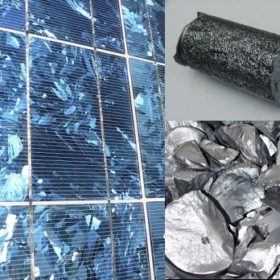
India drafts $1.7bn solar PV manufacturing scheme
India invites suggestions and feedback for its new solar PV manufacturing scheme, which aims to ramp up domestic manufacturing capacity of modules, cells, wafers and ingots, and polysilicon. The scheme is expected to be implemented at the beginning of 2018.