Modi government propelled renewable growth: CEO survey
In a recent survey, an overwhelming 73% of respondents said they remain upbeat about India’s renewable growth prospects, despite recent policy reversals and various other operational challenges the industry faces.
UK researchers seek to use perovskite solar cells for hydrogen production
A research team has applied a waterproof coating obtained from graphite to a perovskite cell intended to power the production of hydrogen underwater. The cell is said to have worked underwater longer than expected.

The long read: Implementing standards
While Bureau of India Standards certification is a genuine attempt by the Indian government to mitigate the risks associated with poor solar module quality, there are several reasons why it is not 100% effective. pv magazine India’s Uma Gupta investigates India’s efforts to ensure quality in its booming PV industry.
Panasonic transfers solar manufacturing unit to GS-Solar and creates new research JV
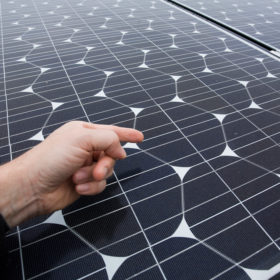
The Japanese multinational will transfer its Panasonic Energy Malaysia unit to Chinese heterojunction module provider GS-Solar as part of a broader cooperation agreement. Panasonic’s solar R&D business will form part of a JV in Japan to be 90% owned by GS-Solar.
New factory-focused solar tender reportedly in the offing
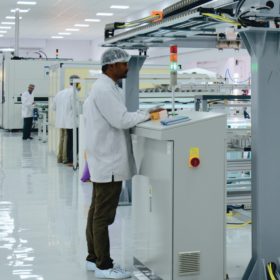
With last year’s embarrassing manufacturing-linked capacity tender limping along, it has been reported that the Indian government – whichever form it takes after the current elections – is considering a new tender to incentivize the establishment of a domestic solar industry.

Australia considers how to profitably upcycle 80 million tons of PV waste
With concern rising about future solar waste in India, research by the University of New South Wales has examined the economic barriers, technologies and opportunities offered by recycling end-of-life silicon PV modules.

Vikram Solar panels are Black & Veatch certified
After a detailed review of solar panels manufactured at Vikram Solar’s plant in West Bengal, US-based Black & Veatch concluded that its modules successfully meet the requirements of respective international standards.
Tackling India’s solar waste challenge
As the nation aims for 100 GW of solar capacity by 2022 it is staring at up to 1.8 million tons of PV waste by 2050. A solar waste management seminar organized by consultancy Bridge To India in New Delhi brought stakeholders together to discuss how a PV waste management system could help.

Q-Cells unveils new half-cell monocrystalline panel
According to the Korean manufacturer, its Q.Peak Duo-G6 module is produced with larger wafers than those used in the G5. This is said to increase module yield by around 6% for a power output ranging from 355-420 W.

Interview: Damian Miller, CEO of rooftop solar supplier Orb Energy
Founded in 2006, Bengaluru-based Orb is a rooftop solar provider that manufactures panels and provides finance for SMEs through a collateral-free loan that matches the payback period for its solar systems. Orb has sold more than 160,000 units in India, with cumulative installations of around 65 MW of PV rooftop capacity.