Off-grid solar plants can be connected to the grid, says MNRE
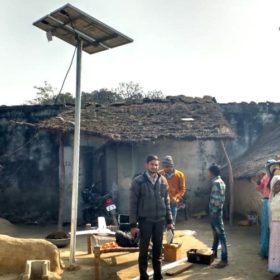
The Ministry of New and Renewable Energy (MNRE) has said that off-grid solar plants that have been installed under its own programmes can be connected to the grid in locations where net-metering provisions are in place.
Global cumulative PV capacity may reach 1.3 TW in 2023, SolarPower Europe says
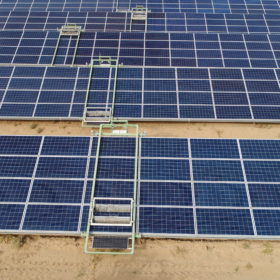
The European solar trade body expects 128 GW of new PV capacity in 2019, with China likely to bring around 43 GW online and Europe experiencing enough demand to deploy about 20.4 GW. In 2020, global solar demand is expected to reach 144 GW, while in the following three years new PV additions are forecast to total 158 GW, 169 GW and 180 GW, respectively.

Modi government propelled renewable growth: CEO survey
In a recent survey, an overwhelming 73% of respondents said they remain upbeat about India’s renewable growth prospects, despite recent policy reversals and various other operational challenges the industry faces.
Tata Power and natural gas supplier MGL partner on e-mobility
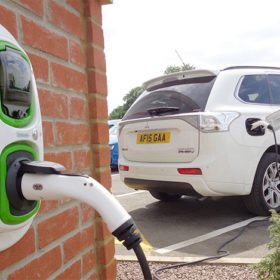
This is Tata Power’s fourth major partnership with an energy retailer to expand its presence in the e-mobility business. As part of the MoU, the private-sector electricity generator with work with Mahanagar Gas Limited (MGL) to set up solar rooftop projects and commercial-scale electric vehicle (EV) charging and battery swapping stations.

India-Canada renewables fund aims for $600m cash pot
A unit of Piramal Group will be investment and project manager for the fund, prompting speculation cash will be spent on assets developed by Mytrah Energy.
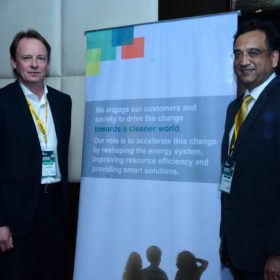
Opportunities beyond solar and EVs: Fortum interview
Waste-to-energy, battery lifecycle solutions and hazardous waste management will make up an increased share of Fortum’s business in future. While solar will continue to be a mainstay for the Finnish clean energy company in India, Fortum wants to deepen its presence in the electric vehicle space with smart solutions, according to Sanjay Aggarwal, the company’s India MD, and Juha Suomi, area director for Asia, who spoke exclusively to pv magazine.

Only two bidders for Gujarat’s 1 GW solar tender
The procurement – for PV capacity at the Dholera Solar Park – attracted bids for just 300 MW as developers shunned a tariff ceiling of Rs2.75/kWh.
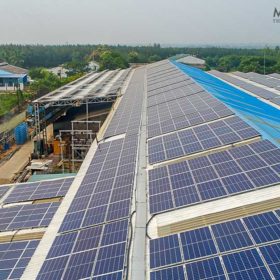
Rooftop solar needs greater push to reach 2022 target: IEEFA
Policy certainty and more financial subsidies would incentivise the market, as would support for domestic manufacturing and simplifying the net metering application process.
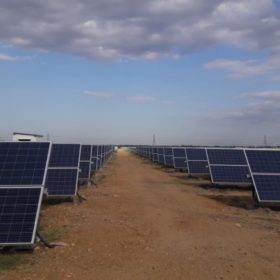
IEA warning against stagnation of renewables
After two decades of growth, the amount of newly installed renewable energy capacity is no longer rising and, despite a 7% growth in electricity generation from clean energy sources, global energy-related carbon emissions have risen 1.7%.
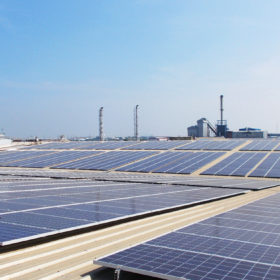
Belectric commissions 26 MW rooftop solar projects for Cleantech Solar
The German EPC contractor is also building a 250 MW AC ground-mounted solar farm in Karnataka. Overall, with an already installed capacity of more than 370 MWp and other projects under implementation, it expects to cross 1 GW of installed capacity in India by the year end.