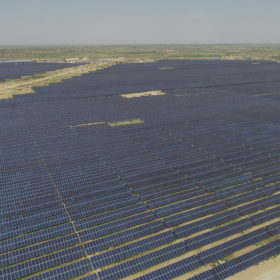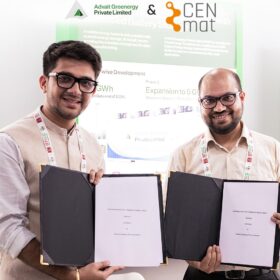
Virescent Renewable Energy Trust raises INR 2,150 crore of debt finance
Virescent Infrastructure shall use the proceeds primarily to refinance special-purpose vehicle (SPV) level debt and fund future acquisitions.
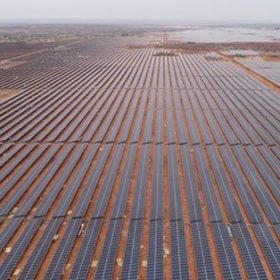
SJVN, Solarworld sign pact for 75 MW solar EPC in Uttar Pradesh
The PV project, located in Parasan Solar Park of the Jalaun District, benefits from a 25-year power purchase agreement with the Uttar Pradesh New and Renewable Energy Development Agency at a tariff of INR 2.68/kWh.

Govt to increase PLI funding for solar manufacturing to INR 24,000 crore
The increase in the financial layout will help accommodate more manufacturers under the government’s production-linked incentives scheme to support gigawatt-scale manufacturing of high-efficiency solar modules.

Hydropower producer SJVN to form solar and storage arm
The company’s board of directors have approved the formation of a wholly-owned subsidiary for solar PV, wind and hybrid power generation (including battery energy storage systems), green hydrogen, and other renewable energy ventures.
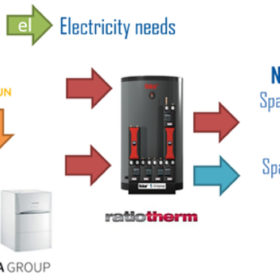
European consortium develops ways to couple heat pumps with solar panels
The Sun Horizon consortium has started to collect performance data on two pilot projects that combine heat pumps with solar systems using hybrid panels on homes in Riga, Latvia. The solution features a heat pump for space heating and domestic hot water and PVT panels to produce power for heating and domestic appliances, with excess power fed to the grid.

Reuse or replace? IEA PVPS analysis considers all options for underperfoming PV modules
In a new report, experts from the International Energy Agency Photovoltaic Power System Programme (IEA-PVPS) have assessed the economical and environmental benefits of repairing and reusing or replacing solar modules that are not complying with a 30-year expected lifetime. They found that reusing offers the best environmental impact in all cases, while the profitability of this option is currently guaranteed only by rooftop PV under certain conditions. As for large-scale solar, module replacement remains the most competitive option.

The long read: Nothing simple about solar O&M
New investors and technological complexity demand new approaches to O&M service provision, argues NovaSource’s Timo Moeller. With larger PV fleets and the ability to process the operational data of generation, pure-play O&M may continue to deliver on solar’s cost learning curve.

Shirdi Sai Electricals gets LoA to set up 4 GW solar fab under PLI Scheme
The Telangana based power distribution transformer manufacturer and installer had placed an INR 1,875 crore incentive bid to set up a fully integrated 4 GW polysilicon-to-module fab under government’s production-linked incentives scheme.

“450 GW by 2030 renewable energy target ambitious but achievable”
At the Renewable Leadership Summit 2021 held recently in New Delhi, Dinesh Jagdale, joint secretary, Ministry of New and Renewable Energy, also asserted the ministry is working on addressing stakeholders’ concerns to ensure the investments keep flowing into RE capacity expansion and equipment manufacturing. The Summit, organized by Solar Association, also saw Solis launch its new-generation PV plant monitoring platform and off-grid hybrid inverters.

Sustaining the battery storage supply chain
Noida-headquartered Lohum plans to expand its integrated lithium-ion battery manufacturing and recycling facility in India to 3 GWh and expand into the US with its first facility. Co-founder Justin Lemmon speaks to pv magazine about how their operations in India will solve the battery supply chain and cost challenge for the nation’s electric mobility and renewable energy ambitions.