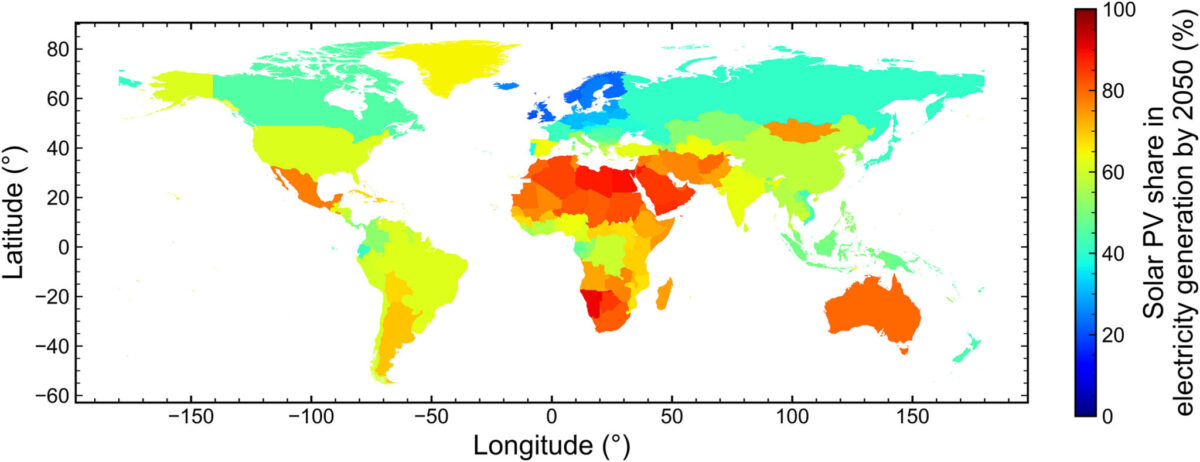





The Capex of photovoltaics is expected to range between €166 ($192)/kW and €720/kW in 2050, according to a new study from Finland’s LUT University.
The researchers noted that €166 value follows the standard convention used in documents to indicate nominal values in 2019 currency, while €720 follows 2017 values. “In short, all cost values prior to 2022 are now adjusted by 20% to account for inflation,” Christian Breyer, professor of Solar Economy at LUT University, told pv magazine.
“Assumptions about solar photovoltaics are often pessimistic,” said co-author Dennis Bredemeier, adding that energy system modeling results can be significantly affected by insufficient spatial or temporal resolution.
The researchers carried out a systematic literature review examining the role of solar PV in energy transition scenarios. They focused in particular on how Capex assumptions influence projected PV shares in the global energy mix, as well as how modeling choices such as temporal resolution, spatial granularity, and technology representation could shape these outcomes. They also explored the relationship between PV full-load hours and country-specific deployment levels, and assessed how the availability of power-to-X pathways could enhance the development and overall system value of solar PV in renewables-based energy systems.
The academics worked on a dataset that was filtered to include only studies achieving at least 95% renewable electricity by 2050, excluding nuclear power. Further selection focused on transition pathway and optimization-based studies that reflect realistic system evolution and cost efficiency. The analysis was limited to studies covering the power, heat, and transport sectors to capture sector coupling effects. Studies with limited geographic scope or insufficient data were excluded to ensure consistency and comparability. Projected PV and wind shares in electricity generation by 2050 were also considered, using electricity share rather than total primary energy demand for consistency. PV full-load hours were estimated using global solar resource datasets.
The literature review ultimately identified 60 studies that met the selection criteria, providing a comprehensive dataset of highly renewable energy transition scenarios. These studies vary significantly in their techno-economic assumptions, reported shares of solar PV and wind, and modeling approaches. Despite these differences, most studies converge on a common outcome: by 2050, solar PV and wind together supply between 80% and 100% of electricity generation. Lower combined shares are typically explained by the presence of other renewable resources such as hydropower or geothermal, or by energy imports.
The analysis also showed that Capex assumptions for solar PV strongly influence its projected share, with lower costs generally leading to higher deployment. Geographic factors further shape results, with countries rich in hydropower or geothermal energy showing lower PV shares, while regions with strong solar resources tend to rely more heavily on PV.
“Assumptions about solar PV are often overly conservative, both in terms of cost and technology representation,” Breyer said. “Many studies rely on Capex projections that exceed current market levels, with some 2050 estimates even higher than costs already achieved today. At the same time, PV is frequently modeled as a generic technology, overlooking the diversity of available solutions such as floating, bifacial, agrivoltaic, vehicle-integrated, building-integrated, and tracking systems. This simplification ignores opportunities to reduce land use or unlock additional deployment potential. In addition, modeling choices—particularly low spatial or temporal resolution—can further distort the estimated role of solar PV in future energy systems.”
This content is protected by copyright and may not be reused. If you want to cooperate with us and would like to reuse some of our content, please contact: editors@pv-magazine.com.





By submitting this form you agree to pv magazine using your data for the purposes of publishing your comment.
Your personal data will only be disclosed or otherwise transmitted to third parties for the purposes of spam filtering or if this is necessary for technical maintenance of the website. Any other transfer to third parties will not take place unless this is justified on the basis of applicable data protection regulations or if pv magazine is legally obliged to do so.
You may revoke this consent at any time with effect for the future, in which case your personal data will be deleted immediately. Otherwise, your data will be deleted if pv magazine has processed your request or the purpose of data storage is fulfilled.
Further information on data privacy can be found in our Data Protection Policy.