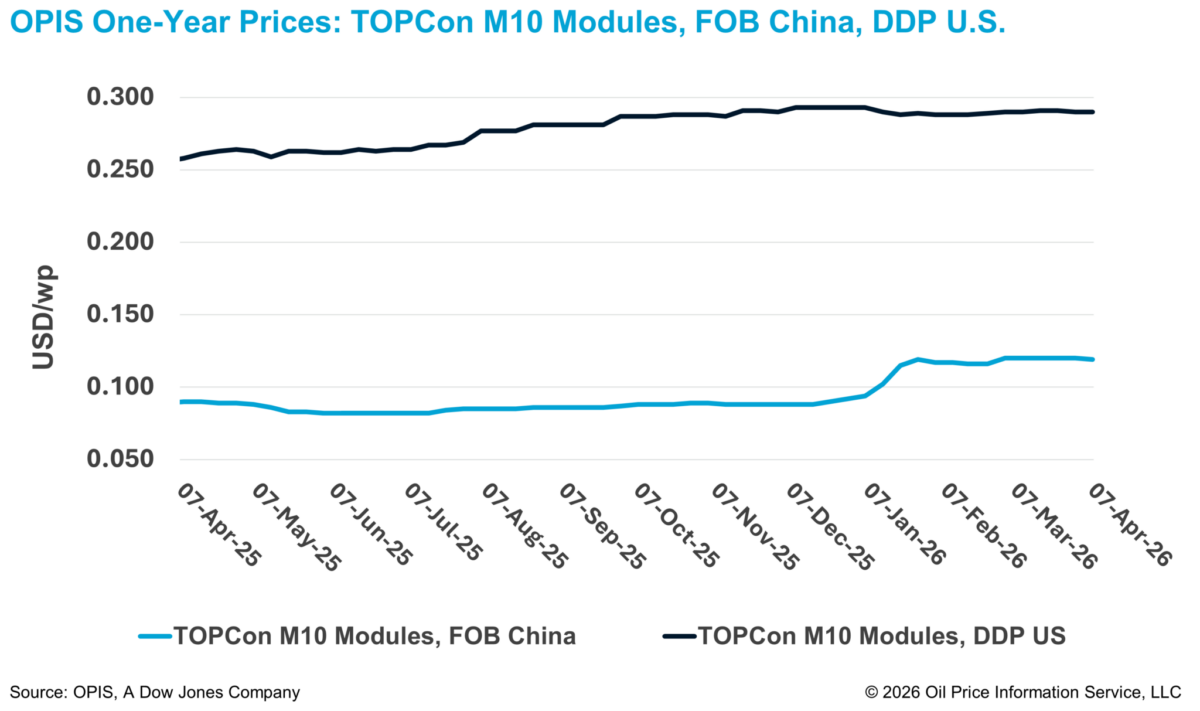





Free-On-Board (FOB) China TOPCon spot loading modules edged lower this week. Trading activity has slowed sharply since the Lunar New Year holidays, with buyers staying on the sidelines amid significant price volatility in the Chinese module market during Q1 2026.
According to the OPIS Global Solar Markets Report released on April 7, the Chinese Module Marker (CMM), the OPIS benchmark assessment for TOPCon modules from China, fell 0.83% to $0.119/W FOB China.
Meanwhile, FOB China TOPCon module forward curve indications softened for later delivery periods, as market participants increasingly priced in weaker demand following the export tax rebate cancellation.
Forward prices for Q4 2026 loading cargoes were assessed at $0.121/W, down 0.82% on the week, while Q1 2027 cargoes were assessed lower by 2.42% to $0.121/W. Q2 2026 and Q3 2026 cargoes held at $0.120/W and $0.121/W, respectively.
Softer spot loading indications were driven by modules sitting in customs warehouses that are not affected by the recent cancellation of the export tax rebate, according to sources.
China removed export tax rebates on PV products, including solar wafers, cells, modules and glass, from April 1. It had previously reduced export tax rebates from 13% to 9% in December 2024 for a range of products, including photovoltaic materials, refined oil, batteries and mineral products.
Market sources said the removal could force manufacturers to absorb part of the added export costs, potentially lifting minimum FOB price levels. One top-tier manufacturer source told OPIS that some market participants had moved modules into customs warehouses before the April 1 deadline, allowing them to benefit from the 9% rebate and price more competitively.
Another producer source told OPIS that they internally are expecting to absorb the lost export tax rebate, given the weak FOB overseas demand in Q2 2026, which has strengthened buyers’ bargaining power.
Sources added that the shift could further widen the gap between stronger and weaker players, with manufacturers that have stronger technology and tighter cost control expected to gain further advantage, while producers with outdated capacity or weaker module performance may face faster consolidation.
While China’s module market is grappling with the aftereffects of the rebate removal, the U.S. market faces a different set of pressures, as buyers await clearer direction on multiple trade and policy fronts.
According to the same OPIS report, DDP US prices for TOPCon modules held at $0.290/W this week. Forward looking indications for the DDP price of TOPCon modules in the first quarter of 2027 were assessed at $0.278/W. Sources say recent forward price indications will be subject to adjustment given pending tariff investigations and ongoing policy uncertainty.
With First Solar’s Section 337 petition in its early stages, market players continue to speculate on the company’s end goal and how the process could play out. A distributor source said it is too soon to start changing suppliers out of fear of the 337 process, while a procurement source said the case could either block competitors or push them toward licensing agreements.
Some Foreign Entity of Concern (FEOC) guidance also remains outstanding, and with the deadline to safe harbor 48E projects nearing this summer, some manufacturers are still working towards production of modules with significant levels of domestic content.
Yet modules with significant domestic content still fetch a premium over similar equipment assembled with imported cells. The distributor source said availability timelines remain uneven, with some manufacturers not expecting such modules until 2027.
OPIS, a Dow Jones company, provides energy prices, news, data, and analysis on gasoline, diesel, jet fuel, LPG/NGL, coal, metals, and chemicals, as well as renewable fuels and environmental commodities. It acquired pricing data assets from Singapore Solar Exchange in 2022 and now publishes the OPIS APAC Solar Weekly Report.
The views and opinions expressed in this article are the author’s own, and do not necessarily reflect those held by pv magazine.
This content is protected by copyright and may not be reused. If you want to cooperate with us and would like to reuse some of our content, please contact: editors@pv-magazine.com.




By submitting this form you agree to pv magazine using your data for the purposes of publishing your comment.
Your personal data will only be disclosed or otherwise transmitted to third parties for the purposes of spam filtering or if this is necessary for technical maintenance of the website. Any other transfer to third parties will not take place unless this is justified on the basis of applicable data protection regulations or if pv magazine is legally obliged to do so.
You may revoke this consent at any time with effect for the future, in which case your personal data will be deleted immediately. Otherwise, your data will be deleted if pv magazine has processed your request or the purpose of data storage is fulfilled.
Further information on data privacy can be found in our Data Protection Policy.