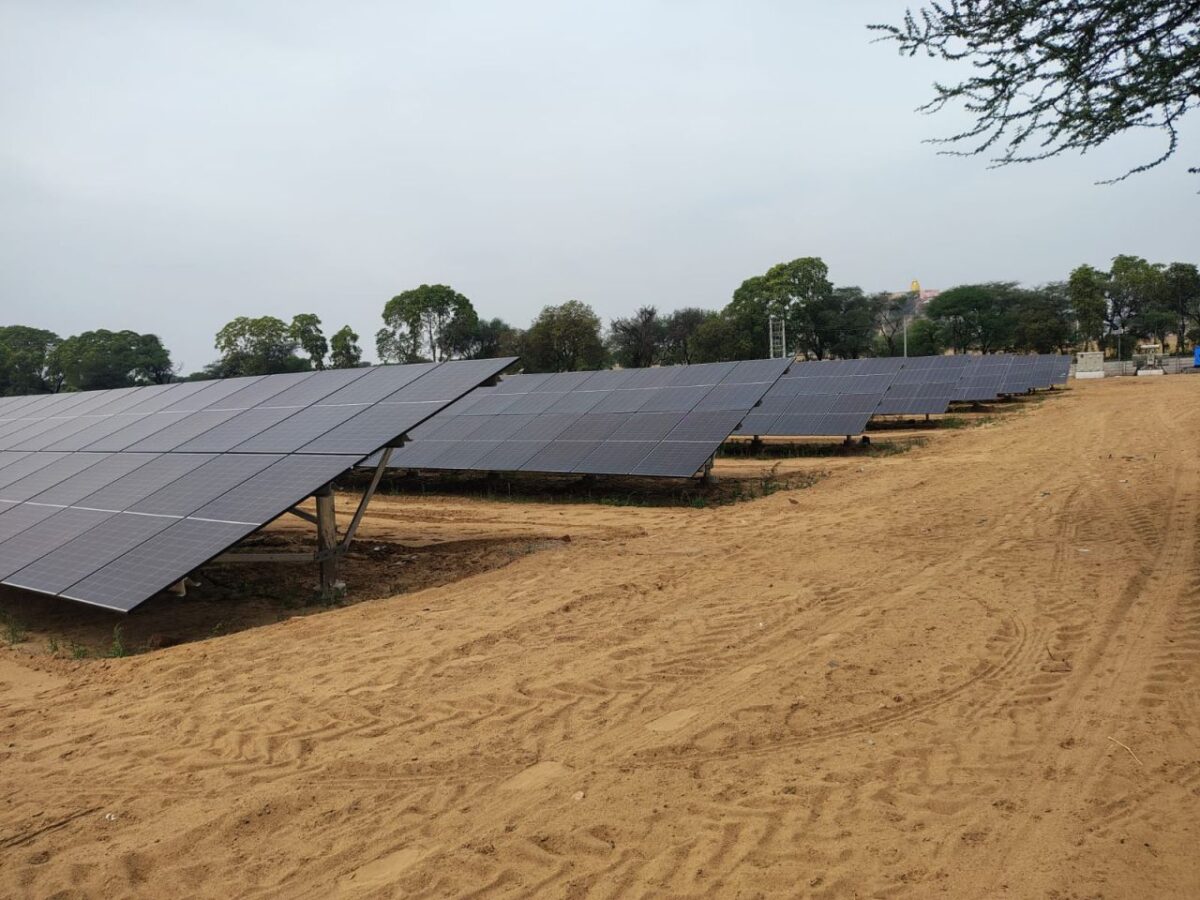





Solar-powered irrigation under the PM KUSUM Scheme offers an opportunity to reduce the agricultural power subsidy burden while providing reliable daytime electricity and boosting farmers’ incomes, according to a new report. However, the report notes several practical challenges that have slowed its uptake.
The report Scaling Solar Power for Irrigation in India: Lessons from PM‑KUSUM by the Council on Energy, Environment and Water (CEEW), the Center for Study of Science, Technology and Policy (CSTEP), and the International Institute for Sustainable Development (IISD), finds that in many states, decentralized solar irrigation already costs INR 3–4 per unit (kWh), far below utilities’ INR 6–7 per unit supply cost.
Using a purpose-designed methodology, researchers estimate that solarizing just 10% of agricultural electricity demand could generate significant savings for states for over a 25-year period—INR 2,543 crore in Rajasthan, INR 6,305 crore in Madhya Pradesh, INR 3,113 crore in Karnataka, and INR 1,935 crore in Tamil Nadu. In Rajasthan alone, these savings are equivalent to more than 12.5% of the state’s annual agricultural power subsidy, highlighting PM-KUSUM’s potential to ease pressure on state budgets.
“Even modest solarization of agricultural power demand can significantly reduce long-term subsidy burdens while delivering reliable electricity to farmers,” said Anas Rahman, senior policy advisor, IISD. “As the scheme enters its next phase, states should focus on tariff design, grid readiness, and payment security to make solar irrigation financially sustainable for both utilities and farmers.”
The study focuses on Component A (small-scale grid-connected solar plants on farmers’ land) and Component C-FLS (feeder-level solarization) of Pradhan Mantri Kisan Urja Suraksha evam Utthaan Mahabhiyan (PM-KUSUM), India’s flagship program to promote solar energy in agriculture. While the scheme has delivered clear benefits, implementation has fallen short of targets. Deployment to date stands at 8.4% under Component A and 38.2% under Component C-FLS.
Beyond fiscal savings, the scheme has also supported jobs and farmer incomes. Over 32,000 jobs have been created from installations under components A and C-FLS, and farmers can earn an estimated 11%–16% annual return on investment by installing 0.5 MW–2 MW solar plants and selling electricity to the grid. Leasing land can generate around INR 30,000 per acre per year.
Despite early interest from states, progress has been slowed by low farmer awareness, land availability constraints, tariff viability challenges, grid limitations, and broader institutional and financial bottlenecks. Addressing these barriers will be critical to scaling impact in the next phase.
A growing pipeline signals readiness for scale
State‑level interest in the scheme has been building. More than 40 GW has been tendered under PM‑KUSUM over the past 2 years, and power purchase agreements have been signed for over 20 GW. Much of the remaining capacity is at the letter-of-award stage, with commissioning timelines of 9–15 months, pointing to a strong near-term pipeline of projects.
“PM‑KUSUM has moved beyond pilots to a scale‑ready pipeline, with significant capacity already tendered and under development,” said Shalu Agrawal, director of programmes at CEEW. “What matters now is execution—getting tariffs rights, reducing payment risk, and integrating projects smoothly into the grid. Done well, solar irrigation will become a cost-effective, mainstream solution for meeting agricultural power demand while easing subsidy pressures.”
With the first phase of the scheme concluded on March 31, 2026, the report recommends a next-generation scheme that incorporates lessons learned and is flexible and investment-ready, enabling states to adapt, innovate, and tailor the scheme to local conditions.
“States have been the real drivers of innovation under PM‑KUSUM,” said Rishu Garg, senior policy specialist, CSTEP. “The next phase must allow states more flexibility, strengthen state implementing agencies, expand planning capacity at the distribution level, and prepare rural grids to handle decentralized solar. Without these institutional foundations, scale will remain uneven across states.”
The challenge ahead is no longer proving the viability of solar irrigation but enabling scale. With the right reforms, PM‑KUSUM can evolve from a promising start into a durable shift toward clean, reliable power for Indian agriculture.
The report makes following key recommendations: ensure tariff viability through competitive bidding or market-linked benchmarks, eas land constraints through geographic information system-based tools and approval-ready land banks, strengthen distribution company ownership and planning, prepare the grid through hosting-capacity assessments and feeder planning, unlock financing through payment security mechanisms and blended finance, and improve farmer uptake through local outreach and extension networks.
This content is protected by copyright and may not be reused. If you want to cooperate with us and would like to reuse some of our content, please contact: editors@pv-magazine.com.





By submitting this form you agree to pv magazine using your data for the purposes of publishing your comment.
Your personal data will only be disclosed or otherwise transmitted to third parties for the purposes of spam filtering or if this is necessary for technical maintenance of the website. Any other transfer to third parties will not take place unless this is justified on the basis of applicable data protection regulations or if pv magazine is legally obliged to do so.
You may revoke this consent at any time with effect for the future, in which case your personal data will be deleted immediately. Otherwise, your data will be deleted if pv magazine has processed your request or the purpose of data storage is fulfilled.
Further information on data privacy can be found in our Data Protection Policy.