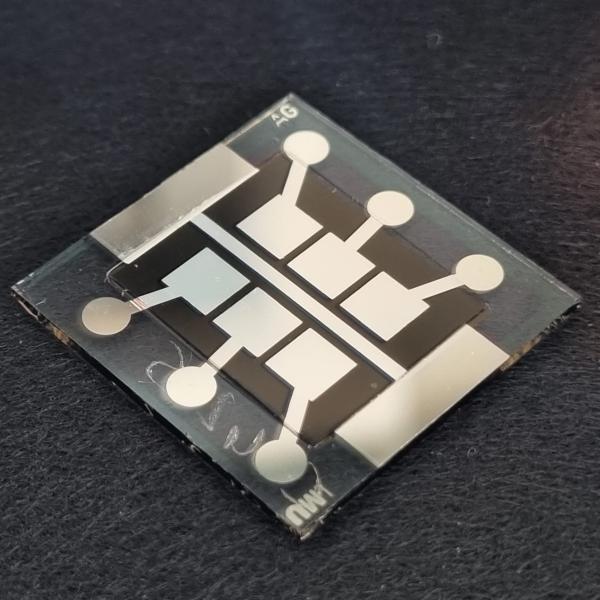





A research team led by Ludwig‑Maximilians‑Universität München (LMU) in Germany has developed a metal‑halide perovskite solar cell capable of withstanding the high temperatures typical of low Earth orbit (LEO) while offering strong power conversion efficiency.
The scientists specifically investigated the effects of accelerated thermal cycling between –80 C and 80 C. They found that the reinforced cells retained around 84% of their initial efficiency after 16 extreme cycles, while unmodified cells suffered significantly greater performance losses.
“Such conditions do not only occur in laboratory aging tests, but also in operational environments such as LEO, where solar cells on satellites are repeatedly exposed to direct sunlight and then plunged into cold within short periods,” the researchers noted. “Temperature extremes vary depending on spacecraft design and orbit, and the team selected a representative range for this study.”
The improvement addresses a key challenge in perovskite solar cells: when the perovskite layer and its glass substrate expand and contract at different rates during temperature fluctuations, mechanical stress builds up. This stress concentrates at the grain boundaries of the perovskite crystals and at the substrate interface, which is the material’s weakest points. Over time, these localized stresses can cause cracks, delamination, and defects, degrading electrical performance and limiting long-term stability.
To overcome these issues, the team developed a targeted molecular reinforcement strategy. They incorporated α‑lipoic acid during film formation, which polymerizes across grain boundaries, reducing defects and strengthening the crystal network. A sulfonium‑based derivative was then applied to chemically anchor the perovskite to the substrate, forming an “anchored net” that stabilizes the layer as it expands and contracts under thermal stress.
Together, these measures protect the cell’s most vulnerable areas, enhancing both durability and efficiency under extreme temperature fluctuations. The device achieved a power conversion efficiency of over 26%, which the academics said is 3% higher than that of a reference cell built without the proposed technique.
“Our work shows that targeted reinforcement of grain boundaries and interfaces can substantially improve the mechanical stability of perovskite solar cells,” said Erkan Aydin, lead author of the study. “This brings us one step closer to making this technology viable for real-world applications.”
The new solar cell concept was introduced in “Perovskite solar cells with enhanced thermal fatigue resistance under extreme temperature cycling,” published in nature communications.
This content is protected by copyright and may not be reused. If you want to cooperate with us and would like to reuse some of our content, please contact: editors@pv-magazine.com.




By submitting this form you agree to pv magazine using your data for the purposes of publishing your comment.
Your personal data will only be disclosed or otherwise transmitted to third parties for the purposes of spam filtering or if this is necessary for technical maintenance of the website. Any other transfer to third parties will not take place unless this is justified on the basis of applicable data protection regulations or if pv magazine is legally obliged to do so.
You may revoke this consent at any time with effect for the future, in which case your personal data will be deleted immediately. Otherwise, your data will be deleted if pv magazine has processed your request or the purpose of data storage is fulfilled.
Further information on data privacy can be found in our Data Protection Policy.