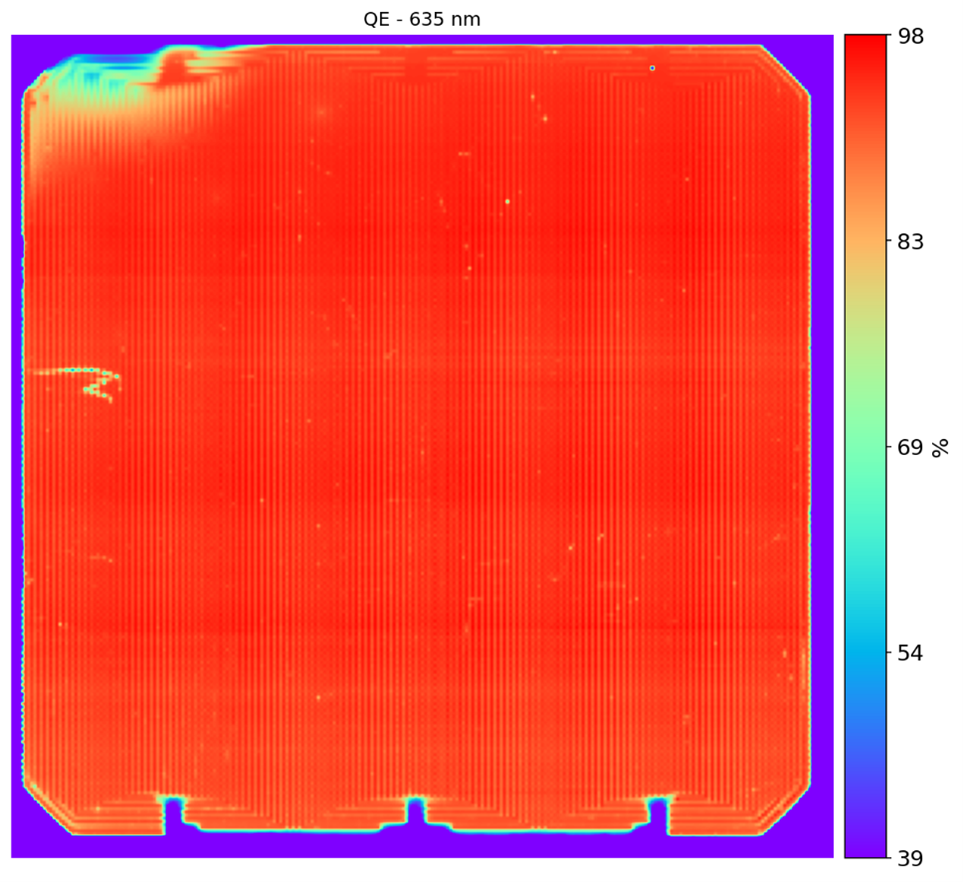





Hbaromega(ℏω), a deep-tech startup specializing in photovoltaic quality control and advanced characterization technologies, has announced encouraging results of adapting its advanced light beam induced current (LBIC) characterization for back contact (BC) solar cells. It said initial studies indicate that the method can deliver significantly deeper diagnostic insights than conventional characterization approaches, offering a more precise understanding of the performance of complex BC architectures.
BC technology has emerged as one of the most prominent trends in today’s PV landscape. With TOPCon already established as the industry’s workhorse technology, many leading PV manufacturers are actively evaluating BC architectures, while some have already launched commercial production at multi-gigawatt scale. Nevertheless, the technology remains subject to extensive optimization.
In this context, LBIC characterization offers a particularly powerful diagnostic tool. In this technique, a focused laser beam scans across the solar cell surface while the generated photocurrent is recorded, producing a high-resolution map of carrier collection efficiency. This approach allows the identification of performance-limiting defects such as microcracks, recombination-active regions, and transport non-uniformities. Unlike luminescence-based techniques, LBIC directly measures collected current under short-circuit conditions, providing a direct indicator of carrier transport efficiency within photovoltaic devices.
BC cells present unique diagnostic challenges due to their architecture, particularly the lateral p-n junction design. Explaining this aspect, Prashant Kumar, CTO of Hbaromega, said: “In BC cells, charge carriers must travel vertically through the bulk of the device and then laterally toward the interdigitated rear contacts. The spacing between these fingers typically ranges from about 0.5 to 2 mm. Carriers generated midway between adjacent contacts may therefore need to diffuse laterally over distances of roughly 250 to 1000 µm before being collected. As a result, the effective diffusion length requirements in BC cells often exceed 1 mm. Under these conditions, device performance becomes strongly transport-limited rather than primarily recombination-limited.”
These characteristics also pose challenges for conventional characterization methods such as electroluminescence (EL) and photoluminescence (PL). According to Prof. K. S. Narayan, Founder Director, Hbaromega, the key advantage of LBIC lies in the precision of its probing mechanism. “In EL and PL, the semiconductor itself acts as the light source, and the emitted light scatters within the device, reducing spatial resolution. LBIC, in contrast, employs an external, highly focused light spot that directly probes the sample. This eliminates internal scattering and significantly improves measurement precision,” he said.
As a result, LBIC can produce sharper signal transitions between grid regions and the cell body, enabling the detection of fine structural variations and localized defects that emission-based methods often miss. The technique can identify rear-contact recombination, recombination between p+ and n+ fingers, bulk lifetime non-uniformities, and lateral transport bottlenecks. By correlating spatial LBIC responses with contact geometries and probe wavelengths, manufacturers can also quantify contact misalignment effects and process-induced degradation zones. This capability allows a comprehensive evaluation of both vertical and lateral transport constraints, helping bridge the gap between laboratory research and industrial-scale BC production.
Another important aspect of Hbaromega’s solution is its industrial applicability. Historically, LBIC has been limited by scanning speed, with full-area mapping of a standard M10 cell often requiring several hours depending on spatial resolution. With advances in high-speed beam positioning, fast data acquisition electronics, optimized scanning algorithms, and parallel signal processing, Hbaromega has developed high-speed LBIC systems capable of mapping full-area solar cells within seconds.
On the commercial front, the company currently offers two product platforms: PV Vision Pro, designed for solar cell characterization, and ModuleXpert, tailored for module-level diagnostics. In addition to their proprietary LBIC capabilities, both systems support EL and PL characterization, providing a comprehensive diagnostic toolkit for photovoltaic manufacturers.
Hbaromega is currently seeking industrial partnerships to further advance the deployment of its characterization technologies in next-generation solar cell manufacturing.
Hbaromega(ℏω), founded in 2019 at the Jawaharlal Nehru Centre for Advanced Scientific Research (JNCASR) in Bengaluru, focuses on developing advanced photovoltaic characterization technologies for research institutions and the solar manufacturing industry.
Through locally engineered instrumentation and physics-driven diagnostics, Hbaromega aims to provide high-performance characterization tools that support the evolving photovoltaic manufacturing ecosystem.
This content is protected by copyright and may not be reused. If you want to cooperate with us and would like to reuse some of our content, please contact: editors@pv-magazine.com.






By submitting this form you agree to pv magazine using your data for the purposes of publishing your comment.
Your personal data will only be disclosed or otherwise transmitted to third parties for the purposes of spam filtering or if this is necessary for technical maintenance of the website. Any other transfer to third parties will not take place unless this is justified on the basis of applicable data protection regulations or if pv magazine is legally obliged to do so.
You may revoke this consent at any time with effect for the future, in which case your personal data will be deleted immediately. Otherwise, your data will be deleted if pv magazine has processed your request or the purpose of data storage is fulfilled.
Further information on data privacy can be found in our Data Protection Policy.