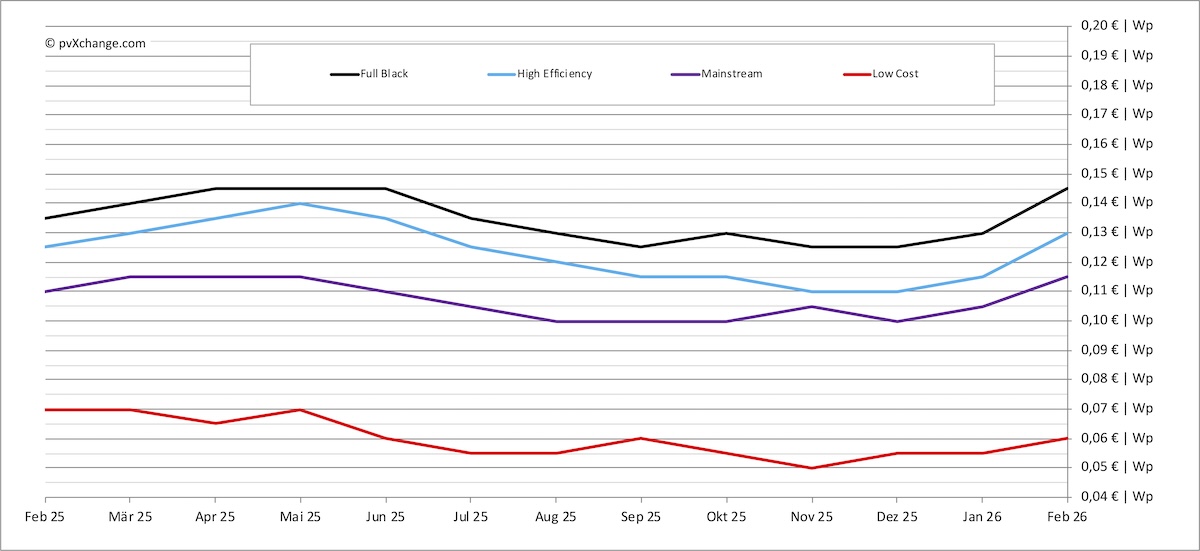





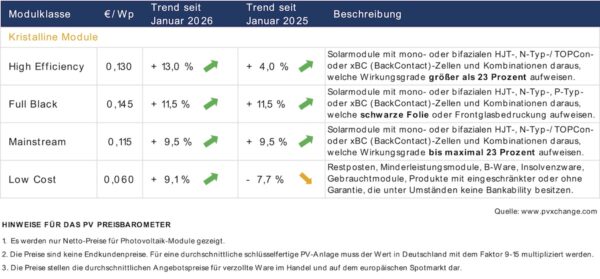
Module prices increased more sharply than anticipated in February across all major technology classes. Most products rose by around €0.01/W to €0.015/W. Modules for small rooftop systems recorded larger increases than utility-scale products. Prices have moved above January 2025 levels and now stand 15% to 18% above the December 2024 low.
The increases are not linked to higher raw material costs or changes to Chinese export subsidies. Wafer prices declined again during the month, while silver prices continued to normalize. The price adjustments appear to reflect manufacturers’ efforts to improve margins after an extended period of losses. Approaches differ, with some suppliers introducing gradual increases and others implementing single-step hikes of 20% to 30%.
Manufacturers with greater exposure to the utility-scale segment have taken a more cautious approach. Project economics in this segment remain highly sensitive to component costs, and significant price increases risk delaying investment decisions. In the residential and commercial rooftop market, module price changes typically compress installer margins rather than directly affecting end-customer demand. Market conditions remain subdued, however, and further demand contraction cannot be ruled out.
Political uncertainty is also affecting sentiment. In the United States, President Donald Trump has signaled a shift in federal climate policy priorities, creating uncertainty around renewable energy deployment. In Germany, early details of the federal government’s proposed network package have drawn criticism from industry representatives and environmental groups concerned about potential delays to grid expansion and renewable integration. The scope and implementation of the proposed measures remain unclear.
The sector is entering a period of adjustment. After several years of rapid expansion supported by favorable policy frameworks, manufacturers and developers are adapting to a more uncertain regulatory environment. Trade associations are preparing policy responses and considering legal options to defend existing frameworks. Public demonstrations have resumed, including a protest outside Germany’s Federal Ministry for Economic Affairs and Energy where decommissioned wind turbine blades and discarded solar modules were displayed to call for continued support for the energy transition.
Industry representatives say coordinated action will be needed to maintain deployment targets and investment stability. Rooftop and ground-mounted PV installations continue to expand, alongside growing interest in battery storage and vehicle-to-grid applications, although policy uncertainty remains a key variable for investment planning.
Module price points by tech on Feb. 18, 2026, including month-on-month changes
The views and opinions expressed in this article are the author’s own, and do not necessarily reflect those held by pv magazine.
This content is protected by copyright and may not be reused. If you want to cooperate with us and would like to reuse some of our content, please contact: editors@pv-magazine.com.



By submitting this form you agree to pv magazine using your data for the purposes of publishing your comment.
Your personal data will only be disclosed or otherwise transmitted to third parties for the purposes of spam filtering or if this is necessary for technical maintenance of the website. Any other transfer to third parties will not take place unless this is justified on the basis of applicable data protection regulations or if pv magazine is legally obliged to do so.
You may revoke this consent at any time with effect for the future, in which case your personal data will be deleted immediately. Otherwise, your data will be deleted if pv magazine has processed your request or the purpose of data storage is fulfilled.
Further information on data privacy can be found in our Data Protection Policy.