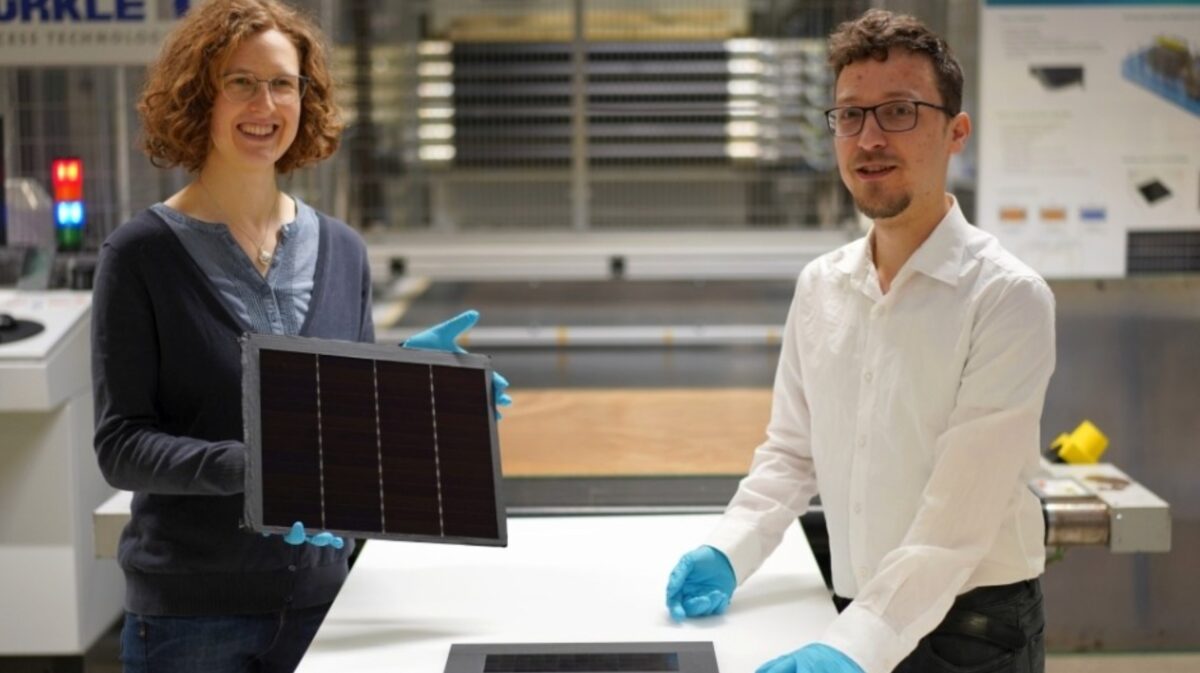





Germany’s Fraunhofer Institute for Solar Energy Systems ISE has developed two III-V tandem PV modules with world record power conversion efficiencies. The team’s modules each feature solar cells based on III-V semiconductor compounds, composed of elements from the third and fifth groups of the periodic table.
The first, a III-V germanium PV module, achieved 34.2% efficiency, which the Fraunhofer team says makes it the most efficient solar module in the world.
The 833 cm2 tandem module was built as part of Fraunhofer’s Vorfahrt project. It consists of triple III-V germanium cells developed by project coordinator Azur Space Solar Power, specialist in multi-junction solar cells for space photovoltaics. A statement from Fraunhofer explains that the manufacturer adapted its triple solar cell technology to the terrestrial solar spectrum, so it can be produced in comparable quantities and in the same wafer formats as its space solar cells.
The module’s efficiency was further improved by nanotechnology specialists temicon GmbH, which transferred a stochastic surface structure onto the glass surface using nano-imprint, helping to minimize reflection losses at the interface of the module.
Fraunhofer has also announced a record 31.3% efficiency for a III-V silicon PV module, which it says is a record for its class.
The module, measuring 218 cm, builds on an efficiency record for III-V silicon solar cells set by Fraunhofer of 36.1%. Through the research project Mod30plus, the team has realized a small-scale production of the solar cells adapted for interconnection with shingle technologies to produce the module.
Fraunhofer ISE scientist and Vorfahrt project lead, Laura Stevens, said the institute is conducting intensive research to replace single solar cells with multiple solar cells in modules as conventional silicon solar cells cannot exceed a physical limit of 29.4%.
“The fact that we achieved a world record with the III-V germanium module shows the great potential in combining multiple semiconductors,” Stevens said.
Andreas Bett, Fraunhofer ISE Director, added that both tandem PV technologies have the potential to fill application gaps between conventional, cost-effective ground-mounted and rooftop systems on one hand, and high-performance but more expensive space solar cells on the other.
“III-V in tandem with silicon as a more affordable option, III-V on germanium as a slightly more efficient alternative, are both interesting technology routes for integrated PV applications, wherever space is limited,” Bett said.
Last July, Fraunhofer achieved 40% efficiency for an indoor III-V solar cell based on an indium gallium phosphide absorber.
This content is protected by copyright and may not be reused. If you want to cooperate with us and would like to reuse some of our content, please contact: editors@pv-magazine.com.



By submitting this form you agree to pv magazine using your data for the purposes of publishing your comment.
Your personal data will only be disclosed or otherwise transmitted to third parties for the purposes of spam filtering or if this is necessary for technical maintenance of the website. Any other transfer to third parties will not take place unless this is justified on the basis of applicable data protection regulations or if pv magazine is legally obliged to do so.
You may revoke this consent at any time with effect for the future, in which case your personal data will be deleted immediately. Otherwise, your data will be deleted if pv magazine has processed your request or the purpose of data storage is fulfilled.
Further information on data privacy can be found in our Data Protection Policy.