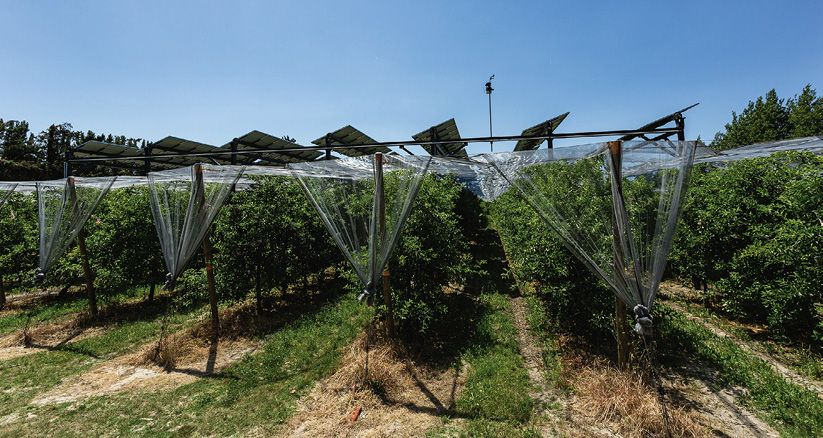





Scientists at Germany’s Thünen Institute of Agricultural Technology proposed incorporating land preservation costs into the modeling of the levelized cost of energy (LCOE) for agrivoltaic projects
“Agrivoltaics can preserve agricultural land more effectively than standard ground‑mounted PV installations by enabling the simultaneous use of land for electricity generation and farming,” the research’s lead author, Jonas Böhm, told pv magazine. “However, our analysis shows that this land‑preservation benefit comes at a substantial cost. These costs must be covered by either the investor, electricity customers, or society.”
He also emphasized that the agricultural output contributes only marginally to the overall economic performance of agrivoltaic systems, as electricity generation remains the dominant source of revenue.
“To quantify the agricultural return to land, we used historical data from the German Farm Accountancy Data Network, which provides long‑term, representative information on agricultural factor incomes in Germany. These data confirm that agricultural value creation is far too small to compensate for the substantially higher system costs of agrivoltaics,” he further explained.
The modeling assumed that agrivoltaic systems must comply with German standards, which require that at least 85% of ground-level installations or 90% of high-mounted systems remain in agricultural production.
For Capex, the researchers considered costs for solar modules, inverters, mounting systems, internal cabling, installation, fencing, transformers, and potentially a substation, along with expenses for land acquisition, biodiversity measures, approvals, structural engineering and environmental reports, project planning, and construction supervision. Opex calculations included monitoring, reporting, inspections, maintenance, remote control capabilities, security, insurance, commercial administration, legal advice, biodiversity conservation, grassland maintenance, cleaning, inverter repairs, and other miscellaneous costs.
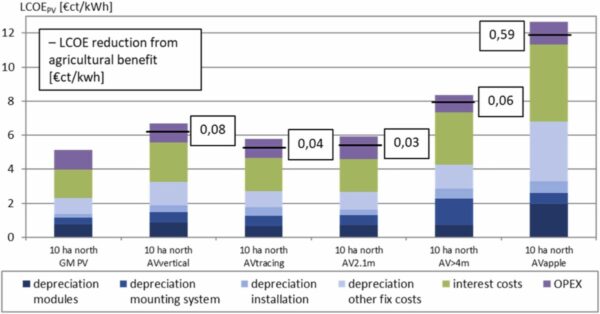
Image: Thünen Institute of Farm Economics, Land Use Policy, CC BY 4.0
Electricity yields were estimated using average global solar radiation data from the German Weather Service (DWD) for four soil climate zones between 2014 and 2023. The cost assessment also factored in agricultural income from land under the agrivoltaic systems, which was credited against total system costs.
Using real cost data from German project developers, the team found that the levelized cost of electricity (LCOE) for agrivoltaic systems is 4% to 148% higher than for conventional ground-mounted PV plants, with applications like agrivoltaics for apple orchards showing the largest cost differences.
“We also found that, when the additional costs of agrivoltaic systems are expressed per hectare of farmland preserved, the societal costs amount to €8,000–26,000 ($9,533–30,982) per hectare per year for medium-height systems and €42,000–75,000 per hectare per year for high-mounted structures,” Böhm said. “These figures are many times higher than the potential agricultural return from the same land.”
“Our results therefore cast doubt on the cost-effectiveness of agrivoltaics as a land-management strategy and raise important questions about the justification for public subsidies,” he added. “While specific concepts, such as agrivoltaics for apple orchards, can create notable synergies—like replacing hail-protection nets—they also carry significantly higher system costs. The lowest additional costs occur in agrivoltaic systems requiring only minimal adjustments from the agricultural sector, such as grassland use or animal husbandry.”
“Rather than broadly subsidizing today’s costly and non-competitive agrivoltaic systems, policy should prioritize supporting the testing and development of new concepts that have a realistic chance of becoming cost-competitive in the future,” he concluded.
The research’s findings are available in the study “Preserving agricultural land with agrivoltaic – But at what cost? An economic analysis of different agrivoltaic systems in Germany,” published in Land Use Policy.
This content is protected by copyright and may not be reused. If you want to cooperate with us and would like to reuse some of our content, please contact: editors@pv-magazine.com.



By submitting this form you agree to pv magazine using your data for the purposes of publishing your comment.
Your personal data will only be disclosed or otherwise transmitted to third parties for the purposes of spam filtering or if this is necessary for technical maintenance of the website. Any other transfer to third parties will not take place unless this is justified on the basis of applicable data protection regulations or if pv magazine is legally obliged to do so.
You may revoke this consent at any time with effect for the future, in which case your personal data will be deleted immediately. Otherwise, your data will be deleted if pv magazine has processed your request or the purpose of data storage is fulfilled.
Further information on data privacy can be found in our Data Protection Policy.