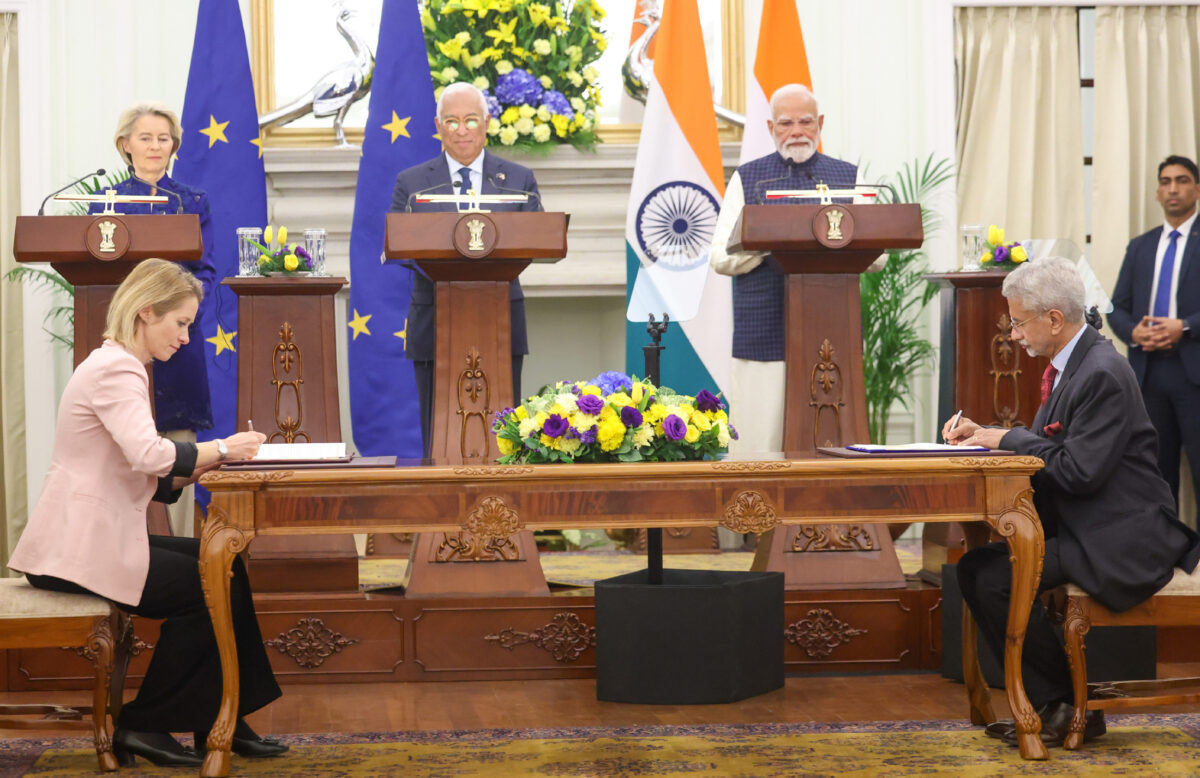





India, the world’s fastest growing major economy, and the European Union (EU) have concluded talks for a long-anticipated free trade agreement (FTA) expected to double bilateral trade—currently at €124 billion ($136 billion)—within five years.
The deal dubbed by India’s Commerce Minister Piyush Goyal and European Commission President Ursula von der Leyen as the “mother of all deals” eliminates tariffs on 90 percent of goods, unlocking €4 billion ($4.4 billion) in annual savings and positioning India to absorb services gains of up to $35 billion. For India, it offers strategic insulation against a renewed wave of U.S. tariffs under a second Trump administration, while for the EU, it secures long-term access to a growing consumer and industrial market at the center of the Indo-Pacific.
The FTA lands in a world geoeconomic confrontation where tariffs, carbon taxes, and industrial policy have become powerful levers, as was evident at the World Economic Forum in Davos where U.S. President Donald Trump threatened to sanction European firms over Arctic minerals. Both India and the EU came into this agreement looking to hedge against the resulting market volatility and policy fragmentation. With New Delhi chairing BRICS and Brussels rethinking transatlantic dependence, the deal is a deliberate move to stitch climate and trade into a stable, rules-based alternative.
Crucially, this FTA is emerging as a platform for climate-trade convergence. The climate dimension is not incidental—it’s already embedded in ongoing India–EU frameworks. The Clean Energy and Climate Partnership (CECP), first signed in 2016, continues to coordinate joint work on renewables, energy efficiency, and clean hydrogen. Green hydrogen is a growing pillar in this partnership, with the EU and India both signaling the fuel’s centrality to their decarbonization pathways.
Alongside CECP, the EU–India Trade and Technology Council (TTC), is driving clean energy tech coordination, including work on regulatory interoperability and green research and development. India’s prominent role at European Hydrogen Week in Rotterdam last year underscored its ambition to become a hydrogen exporter to Europe, supported by a growing domestic electrolyser manufacturing base, given India targets $10 billion FDI for 10 GW electrolysers by 2030—a pillar for EU import needs. These strands—hydrogen, clean grids, and resilient infrastructure—are increasingly seen as complementary to the FTA framework, even if not formally encoded in treaty text yet.
Another layer of climate-trade complexity is the EU’s Carbon Border Adjustment Mechanism (CBAM), the world’s first carbon tariff on imports, currently in its transitional phase. While CBAM poses a real cost risk to Indian exporters—estimated at $2–4 billion annually when fully implemented in 2026—it is also driving negotiations on how India’s emerging carbon market might interface with EU standards. No formal alignment exists yet, but both sides have acknowledged the need to avoid trade frictions while enabling climate ambition. Monitoring, reporting, and verification (MRV) standards are under discussion as potential areas of mutual recognition.
The EU FTA acts as a partial offset, potentially boosting exports by up to $50 billion by 2031 through services and diversified markets, while cementing India’s “China Plus One” role for resilient manufacturing. From Delhi’s view, this diversifies away from US volatility without compromising core sectors. The European Investment Bank (EIB), another key EU institution, had already committed €2 billion in financing toward climate-resilient infrastructure in India through the Coalition for Disaster Resilient Infrastructure (CDRI). This is part of a broader signal that the EU is willing to back its trade commitments with patient capital and technical support in the energy transition.
Taken together, the FTA arrives as a hedge and a springboard that can help buffer India against protectionist headwinds from the U.S. while reinforcing the case for middle-power leadership as BRICS chair. It also offers the EU a blueprint for climate-integrated trade —spanning hydrogen markets, carbon pricing alignment, and green investment—that survives tariff shocks and geopolitical fragmentation.
“The deal signifies strategic alignment at a moment of high geopolitical uncertainty. The EU has been the reigning power and India is a rising power. The coming together of these global powers, especially on climate goals, green industry and clean tech shows which way money and markets are going. The deal signals constructive alignment , building trust and giving a chance to multilateralism which will now be more and more based on strategic choices.” – Aarti Khosla, Founder-Director, Climate Trends
“The EU is already India’s largest trading partner. Conclusion of the FTA, long in the making, is a landmark moment. It can be the building block for something more ambitious: a strategic partnership that goes beyond trade providing an a stable anchor to boost economic growth, build resilience, improve energy security, and build a future-ready, collaborative relationship. Both sides face a common challenge: building clean energy industries without concentrated dependencies. The complementarity is real, the opportunity is significant, and the timing is right. A deeper partnership with clean tech as a foundation would build resilience, not just for both regions, but for global clean energy supply chains.” – Madhura Joshi, Programme Lead – Asia, E3G
The views and opinions expressed in this article are the author’s own, and do not necessarily reflect those held by pv magazine.
This content is protected by copyright and may not be reused. If you want to cooperate with us and would like to reuse some of our content, please contact: editors@pv-magazine.com.




By submitting this form you agree to pv magazine using your data for the purposes of publishing your comment.
Your personal data will only be disclosed or otherwise transmitted to third parties for the purposes of spam filtering or if this is necessary for technical maintenance of the website. Any other transfer to third parties will not take place unless this is justified on the basis of applicable data protection regulations or if pv magazine is legally obliged to do so.
You may revoke this consent at any time with effect for the future, in which case your personal data will be deleted immediately. Otherwise, your data will be deleted if pv magazine has processed your request or the purpose of data storage is fulfilled.
Further information on data privacy can be found in our Data Protection Policy.