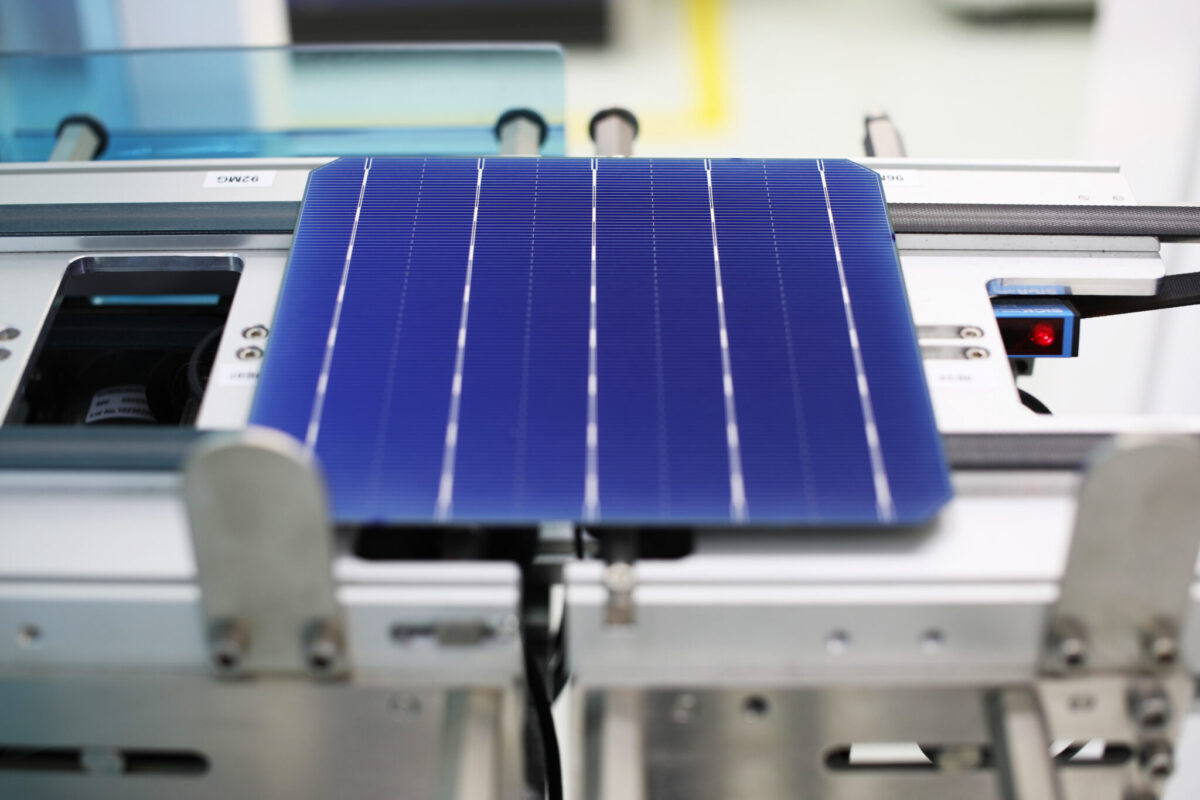





Silver prices are surging, with $100 per troy ounce within reach, putting heavy pressure on the PV supply chain, where at current levels at least one/fifth of module costs goes to silver for cell metallization. China-based metallization paste supplier DK Electronic Materials highlighted this trend, revealing that a gigawatt-scale customer will adopt its high-copper paste for commercial production.
“We anticipate that 2026 will mark the first year of large-scale mass production for high-copper paste solutions. GW-scale TOPCon customer has already signaled ambitions for much broader deployment, while other Tier-1 cell and module manufacturers are actively accelerating their evaluation and adoption efforts,” Kevin Nan, Vice President of Technology and Marketing at DK Electronic Materials, told pv magazine. “A broader set of customers is expected to reach mass-production-level deployment in 2026. Notably, high-copper paste solutions are emerging as a meaningful differentiator in the cost structure of high-power TOPCon modules, extending beyond simple reductions in cell-level metallization costs.”
According to Nan, some customers seem to be flexible considering the trade-off between silver reduction and conversion efficiency. “When customers prioritize maximum silver reduction, conversion efficiency may be marginally below the production-line baseline,” he said. “By contrast, at moderate-to-high levels of silver reduction, conversion efficiency can match—or even slightly exceed—the benchmark. Based on aggregated customer validation results and mass-production data, cell conversion efficiency achieved with our high-copper paste solutions is broadly comparable to existing mass-production benchmarks.”
However, Andreas Lorenz of Germany’s Fraunhofer Institute for Solar Energy Systems (Fraunhofer ISE) states that the PV industry should avoid any trade-off. “In my opinion, lower module efficiency is not acceptable at this time, even if it could reduce module costs,” he said to pv magazine. “The high pressure from rising silver prices will greatly accelerate the development of solutions for the reduction and substitution of silver. Major PV manufacturers have already announced the use of copper-containing pastes for back contact and TOPCon cells to address this challenge.”
Lorenz, who heads the printing group at Fraunhofer ISE, added that for now, silver-coated copper pastes, just like the one DK Electronic Materials produces, are the most effective immediate approach to reducing silver consumption. However, this approach does not eliminate the use of silver, and other methods are currently being researched and considered for the long term.
“The possibility of a further increasing supply deficit for physical silver and sharply rising prices makes silver a very high priority issue for the PV industry,” Lorenz said. “I am convinced that screen printing will continue to be the method of choice for the metallization of silicon solar cells. Possible long-term alternatives are pastes based on copper, nickel, or aluminum instead of silver. Promising results have already been demonstrated at the R&D level for different paste-based approaches. However, there is still some work to do as certain questions, like the long-term stability in the module, are not fully answered yet.”
Nan from DK Electronic Materials has highlighted that, unlike high-copper paste, “pure copper paste solutions are not yet technically mature. They will require additional time to mitigate copper oxidation, to clarify and empirically validate copper diffusion risk-management mechanisms, and to establish a supporting industrial ecosystem spanning materials and equipment. While the short-term driver for GW-scale TOPCon customers to accelerate the mass production of high-copper paste is the pressure from surging silver prices, the medium- to long-term driver lies in sustainability concerns surrounding the supply of photovoltaic-grade silver.”
This content is protected by copyright and may not be reused. If you want to cooperate with us and would like to reuse some of our content, please contact: editors@pv-magazine.com.




By submitting this form you agree to pv magazine using your data for the purposes of publishing your comment.
Your personal data will only be disclosed or otherwise transmitted to third parties for the purposes of spam filtering or if this is necessary for technical maintenance of the website. Any other transfer to third parties will not take place unless this is justified on the basis of applicable data protection regulations or if pv magazine is legally obliged to do so.
You may revoke this consent at any time with effect for the future, in which case your personal data will be deleted immediately. Otherwise, your data will be deleted if pv magazine has processed your request or the purpose of data storage is fulfilled.
Further information on data privacy can be found in our Data Protection Policy.