





From pv magazine Global
University of Exeter researchers compared east-west (E-W), north-south (N-S), and azimuthal single-axis tracking floating PV systems, simulating 10 MWp plants on lakes and reservoirs from northern Scotland to southern Cornwall, United Kingdom. Fixed-tilt systems were included as a reference. Azimuthal tracking rotates a fixed-tilt array, similar to a turntable.
“While the UK continues to prioritise wind energy, this study shows that floating solar is now competitive with other marine-based renewable technologies,” corresponding author Aritra Ghosh told pv magazine. “The analysis covers 12 lake sites across the UK, ranging from northern Scotland to southern Cornwall, providing a clear picture of regional performance.”
Using PVsyst, 10 MWp FPV configurations were simulated with E-W, N-S, and azimuthal single-axis tracking, along with fixed-tilt systems as references. Six of those were located across England, three in Scotland, two in Wales, and one in Northern Ireland. They all used 23,040 440 W monocrystalline mono-facial half-cell modules, with 128 89 kW inverters. The arrays in the azimuthal case were 32.7 m in diameter, with a spacing of 1.8 m between adjacent circular arrays. In both the azimuthal and reference cases, the modules’ tilt angles were optimized for each location.
“The benefit of single-axis tracking is greatest for higher latitude sites due to the more significant mitigation of shading losses,” the researchers said. “Azimuthal single-axis tracking yielded the highest benefit in specific production of any tracking system, achieving a 26.9% increase compared to fixed FPV, compared to maximums of 9.1% and 20.2% for E-W and N-S single-axis tracking systems, respectively.”
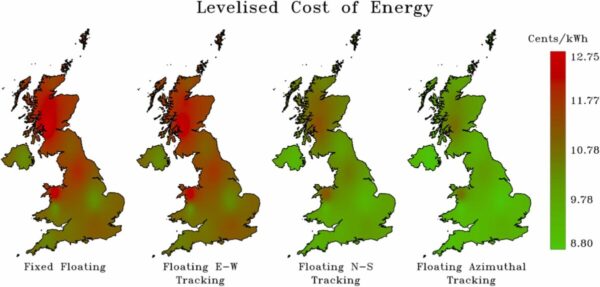
Image: University of Exeter, Energy 360, CC BY 4.0
The team also conducted an economic analysis of all systems across 12 lakes and reservoirs. In their study, they assumed an initial investment of $12.9 million for a fixed FPV system, whereas a single-axis FPV requires an initial investment of $14.1 million. Among other variables, they assumed that both systems had a lifetime of 30 years and a levelized operating expenditure of $155,000. The real discount rate was set at 5.1%, and inflation at 2.5%.
“The most striking finding comes from the azimuthal single-axis tracking, which delivered the lowest levelized cost of energy (LCOE), ranging from 8.80 c/kWh to 10.82 c/kWh across the UK sites studied,” said Ghosh.
He added that “the UK FPV results are unexpectedly competitive, particularly given the country’s Lower solar irradiance. These findings suggest that floating solar – especially when combined with tracking – can play a meaningful role alongside wind in the UK’s marine renewables mix, offering a scalable and cost-effective pathway for further clean energy deployment.”
The researchers presented their results in “Investigation of fixed and East-West, North-South, and azimuthal single-axis tracking for floating photovoltaics (Floatovoltaics) in the UK,” which was recently published in Energy 360.
This content is protected by copyright and may not be reused. If you want to cooperate with us and would like to reuse some of our content, please contact: editors@pv-magazine.com.





By submitting this form you agree to pv magazine using your data for the purposes of publishing your comment.
Your personal data will only be disclosed or otherwise transmitted to third parties for the purposes of spam filtering or if this is necessary for technical maintenance of the website. Any other transfer to third parties will not take place unless this is justified on the basis of applicable data protection regulations or if pv magazine is legally obliged to do so.
You may revoke this consent at any time with effect for the future, in which case your personal data will be deleted immediately. Otherwise, your data will be deleted if pv magazine has processed your request or the purpose of data storage is fulfilled.
Further information on data privacy can be found in our Data Protection Policy.