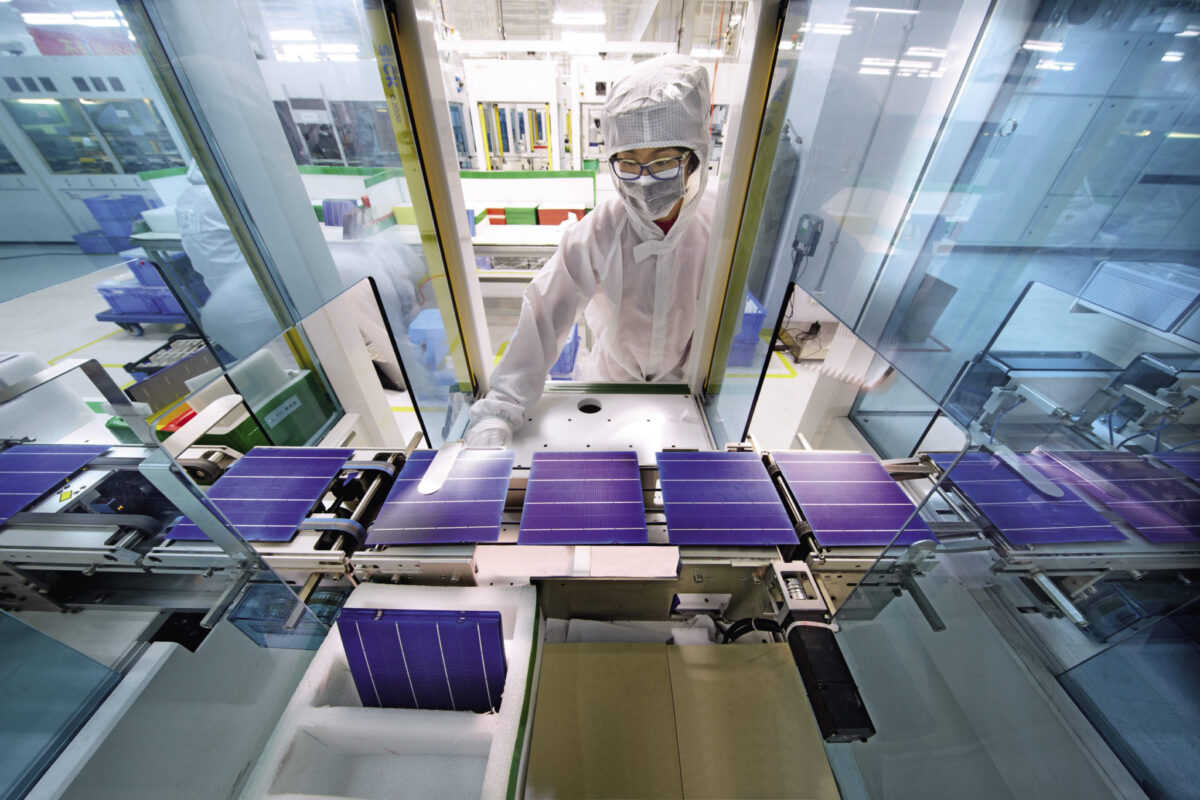





Trina Solar said its researchers have achieved new certified benchmarks in perovskite-crystalline silicon tandem solar cell efficiency and module power output, which the company described as world records for industrial-format devices.
The company said an industrial-scale tandem solar cell using a 210 mm half-cut format achieved a certified power conversion efficiency of 32.6%, while a standard-size tandem module integrating the cells delivered a peak power output of 865 W. It said both results have been independently verified by European testing bodies and represent world-record performance for industrially relevant formats.
The tandem cell was jointly developed with China’s Huairou Laboratory and certified by Fraunhofer Institute for Solar Energy Systems CalLab, while the corresponding module, with an area of 3.1 square meters aligned with mainstream utility-scale designs, was certified by TÜV SÜD.
Trina said Huairou Laboratory contributed advances in perovskite absorber and functional layer materials, while the company focused on process integration, large-area fabrication and compatibility with industrial production lines. The work was carried out within Trina’s Photovoltaic Science and Technology National Key Laboratory.
“We are pleased to announce two new world records in perovskite-crystalline silicon tandem solar technology through effective collaboration,” said Dr. Yifeng Chen, vice president of Trina Solar. He added that the results mark “a milestone for next-generation high-efficiency photovoltaics” and demonstrate the commercial potential of tandem architectures beyond laboratory prototypes.
Trina Solar said the latest results build on a series of tandem milestones reported over the past two years, including certified tandem modules exceeding 800 W and tandem cell efficiencies above 31% on industrial wafer formats. The company claimed it has now created or broken global benchmarks in solar cell efficiency or module power output 37 times.
As crystalline silicon technologies such as tunnel oxide passivated contact (TOPCon) and heterojunction approach practical efficiency limits, tandem architectures combining perovskite and silicon are widely viewed as the most viable route to further performance gains. Trina said demonstrating record results on industrial formats is intended to support eventual commercial deployment.
In April, rival Longi achieved a certified power conversion efficiency of 34.85% for a two-terminal perovskite–silicon tandem solar cell, certified by the US National Renewable Energy Laboratory. The company described the result as a world benchmark for this tandem cell format, underscoring advances in next-generation high-efficiency photovoltaics.
This content is protected by copyright and may not be reused. If you want to cooperate with us and would like to reuse some of our content, please contact: editors@pv-magazine.com.


By submitting this form you agree to pv magazine using your data for the purposes of publishing your comment.
Your personal data will only be disclosed or otherwise transmitted to third parties for the purposes of spam filtering or if this is necessary for technical maintenance of the website. Any other transfer to third parties will not take place unless this is justified on the basis of applicable data protection regulations or if pv magazine is legally obliged to do so.
You may revoke this consent at any time with effect for the future, in which case your personal data will be deleted immediately. Otherwise, your data will be deleted if pv magazine has processed your request or the purpose of data storage is fulfilled.
Further information on data privacy can be found in our Data Protection Policy.