Tata Power, Imperial College London collaborate to advance next-generation energy systems

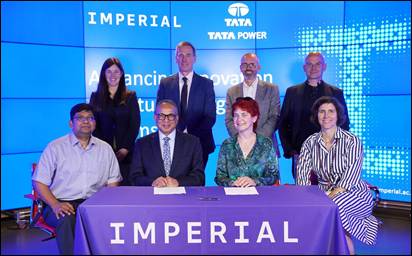
Tata Power and Imperial College London have signed a Memorandum of Understanding (MoU) to explore opportunities for collaboration in research, technology and knowledge exchange across critical areas of the energy transition.
The collaboration will focus on areas including grid flexibility, energy storage, AI and ML applications in energy, and advanced energy systems.
The partnership combines Tata Power’s experience of developing and operating energy infrastructure at scale with Imperial’s research expertise across digital technologies and decarbonisation. It comes as India and the UK deepen cooperation on clean energy and climate action. Under the India–UK Vision 2035, the two countries have identified energy storage and grid transformation as areas for greater cooperation, alongside joint work on AI, renewables, energy storage, hydrogen and carbon capture. The Vision also highlights the Net Zero Innovation Partnership as a vehicle for supporting deep-tech solutions and new markets for climate innovation.
“India’s energy transition is entering a phase where scale, flexibility and reliability will be as important as the pace of renewable energy growth. The next generation of grids, storage and digital energy systems will need to work together to meet a rapidly evolving demand landscape,” said Praveer Sinha, CEO & MD, Tata Power. “Our collaboration with Imperial College will help solve real-world industry challenges with deep research and new thinking and explore solutions that can be relevant not only to India’s energy journey, but also to the wider global transition.”
Tata Power brings extensive experience across power generation, transmission, distribution and renewable energy, while Imperial contributes research capabilities spanning energy systems, engineering, digital technologies, economics and decarbonisation.
This content is protected by copyright and may not be reused. If you want to cooperate with us and would like to reuse some of our content, please contact: [email protected].

Please login to comment