Three-month ISTS delay could widen FY27 renewable evacuation gap beyond 40GW, risking INR 18 billion in revenue

The growing gap between renewable energy (RE) commissioning and transmission readiness is emerging as a key credit risk for the sector. While around 112 GW out of the planned 196 GW RE pipeline till FY32 remains aligned with transmission schedules, about 84 GW of capacity faces delays in general network access (GNA) operationalisation, highlighting a persistent transmission execution gap.
Ind-Ra projects a 32 GW mismatch between generation and transmission for projects commissioning by 2HFY27. This gap may widen to 40 GW, if interstate transmission system (ISTS) commissioning is delayed by three more months beyond the current commissioning timelines.
If a project operates ahead of transmission readiness, it must use temporary general network access (T-GNA), which can lead to curtailment due to grid constraints. Operating 40 GW in T-GNA for three months at a 40% curtailment could lead to a 6.9 TWh generation loss, putting nearly INR 18 billion in revenue at risk for the sector.
Ind-Ra-rated renewable projects have not witnessed material rating pressure from transmission delays so far, supported by repayment moratoriums, liquidity buffers, and sponsor support mechanisms. However, prolonged transmission bottlenecks could weaken capital structure and lead to sustained reliance on sponsors.
Utility-backed projects benefit from partial protection, as the scheduled commercial operation date (SCOD) under power purchase agreements (PPA) is allowed till 30-60 days post receipt of final GNA, thus possibly leading to 25-year PPA tenor being protected. However, the sale of power during T-GNA period is likely in merchant market leading to volume and price risk. For commercial & industrial projects, risks could arise if consumers have the option to exit the project as per respective PPA terms due to prolonged delays in final GNA and consequent supply being lower than committed level during T-GNA period.
Transmission execution: Emerging key constraint on renewable integration
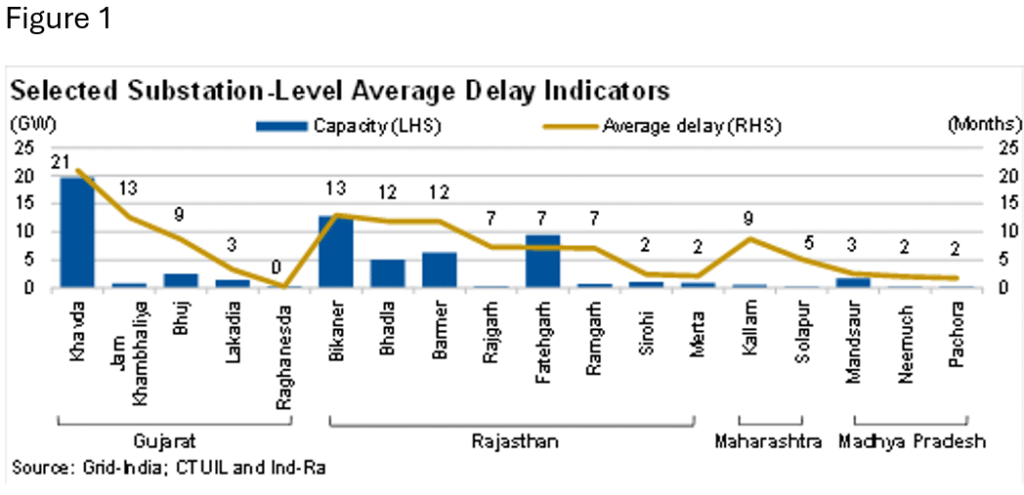
Ind-Ra believes the challenge is no longer transmission planning, but its timely execution. While around 57% of the RE pipeline remains synchronised with transmission commissioning timelines, nearly 84 GW continues to face delays ranging from a few months to over a year.
“Risks are increasingly concentrated in a handful of large RE hubs, where evacuation infrastructure continues to lag generation capacity additions, with an average delay exceeding six months. Key RE hubs contribute significantly to the 84GW capacity associated with GNA delays, accounting for nearly 42GW of the total. This indicates execution slippages at a limited number of substations could materially influence RE integration across India”, says Peeush Middha, Associate Director, Infrastructure, Ind-Ra.
Modest transmission slippages could nearly double RE evacuation gap
Ind-Ra scenario analysis highlights the increasing sensitivity of RE integration to transmission readiness. Based on Central Transmission Utility of India Limited’s (CTUIL) timelines, the evacuation gap across the Western and Northern regions is estimated at around 32 GW by 2HFY27. However, a further three-month delay in transmission commissioning could materially increase the mismatch to over 40 GW. This underscores that the pace of transmission asset execution, rather than RE capacity addition, is likely to be the key determinant of how effectively new RE projects can be integrated into the grid over the medium term.
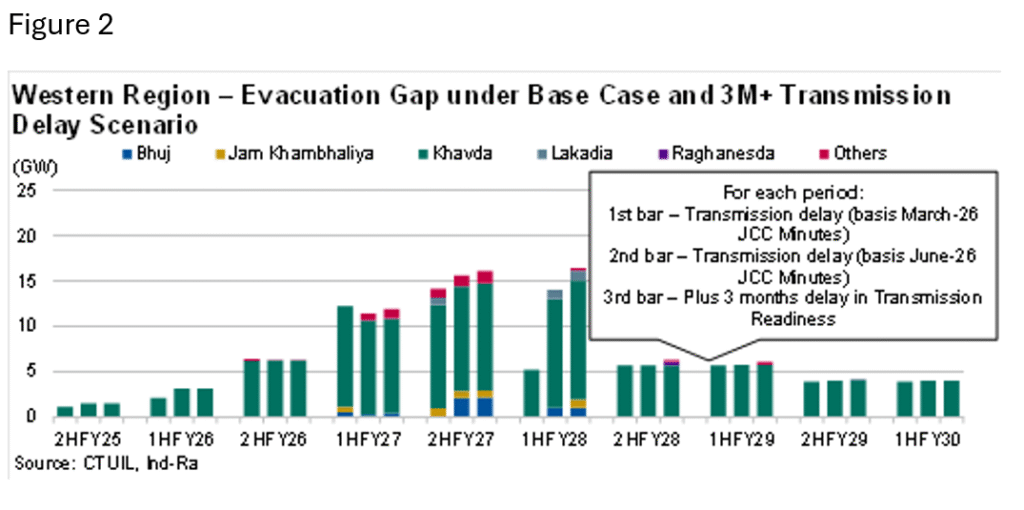
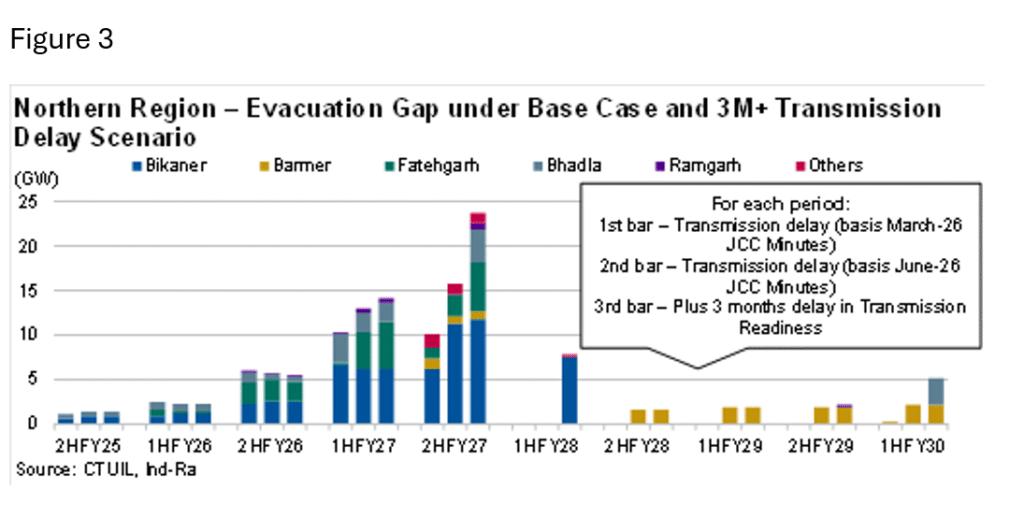
The increase in the estimated generation-transmission mismatch to around 32 GW under the June 2026 JCC timelines, from around 24 GW under the March 2026 timelines, reflects further execution slippages at a few large RE evacuation hubs. Incremental delays have been most pronounced across Rajasthan pooling stations, with Barmer, Bikaner, Ramgarh, Fatehgarh, and Bhadla witnessing additional delays of three to 10 months. In the western region, key substations such as Jam Khambhaliya, Neemuch and Khavda have witnessed further delays of two to six months. This highlights the increasing concentration of transmission execution risk at a limited number of high-capacity RE evacuation hubs.
Curtailment risks could weaken cash flows and increase credit pressure
Ind-Ra has observed a curtailment in the range of 30% to 70% in T-GNA projects. The resulting pressure on project cash flows could reduce equity internal rates of return by 80bp at curtailment levels of 40% for six months and impact increases to 140bp if curtailment period is 12 months. At 80% curtailment, the impact could increase to around 150bp for six months TGNA scenario and 300bp for 12-months T-GNA scenario, highlighting the high sensitivity of project returns to both the duration of T‑GNA reliance and the extent of curtailment.
“Although most projects benefit from principal repayment moratoriums post-COD, and utility-backed projects receive partial protection through PPA tenors commencing after receipt of final GNA, prolonged reliance on T-GNA could increase sponsor support requirements, particularly after scheduled debt repayments commence. Merchant and C&I-linked projects remain exposed to incremental curtailment risk arising from grid stability events, even after the operationalisation of final GNA. Such risks can be mitigated by aligning project commissioning schedules more closely with transmission readiness and incorporating adequate risk-sharing mechanisms in power purchase agreements,” says Samant Kumar Jha, associate director, Infrastructure Ratings, Ind-Ra.
The draft fifth amendment to Central Electricity Regulatory Commission’s Sharing of Inter-State Transmission Charges and Losses Regulations, 2020 proposes that the ISTS waiver will apply if projects achieve COD within 60 days from the final GNA. RE, battery energy storage system, green ammonia, and green hydrogen projects must meet specific COD timelines to qualify for the ISTS charge waiver. However, the regulations lack a framework for the waiver’s applicability if developers choose to align COD with ISTS readiness rather than the prescribed timelines. While the draft aims to provide relief, aligning investments in these with transmission assets can pose practical difficulties and affect the project economics.
Ind‑Ra believes grid readiness is part of completion risk, alongside construction risk, and is critical for assessing RE project credit profiles. This is due to the potential impact of evacuation constraints on project cash flows and returns.
The views and opinions expressed in this article are the author’s own, and do not necessarily reflect those held by pv magazine.
This content is protected by copyright and may not be reused. If you want to cooperate with us and would like to reuse some of our content, please contact: [email protected].
Please login to comment