India adds 4.6 GWh of battery energy storage capacity in Q1 2026: Mercom


India added 4.6 GWh of battery energy storage system (BESS) capacity in the first quarter of 2026, marking a 939% quarter-on-quarter increase from the 442.7 MWh added in Q4 2025, according to Mercom India Research’s Q1 2026 India Energy Storage Landscape Report.
The nation’s cumulative installed battery energy storage capacity reached 5.9 GWh as of March 2026.
Standalone energy storage accounted for 73% of India’s cumulative BESS capacity, followed by 15% from solar-plus-wind with storage (round-the-clock RE power) projects, and 11% from solar-plus-energy storage projects. The remaining share was split among emerging configurations, including solar-plus-wind with storage and floating solar with storage, each contributing less than 1%.
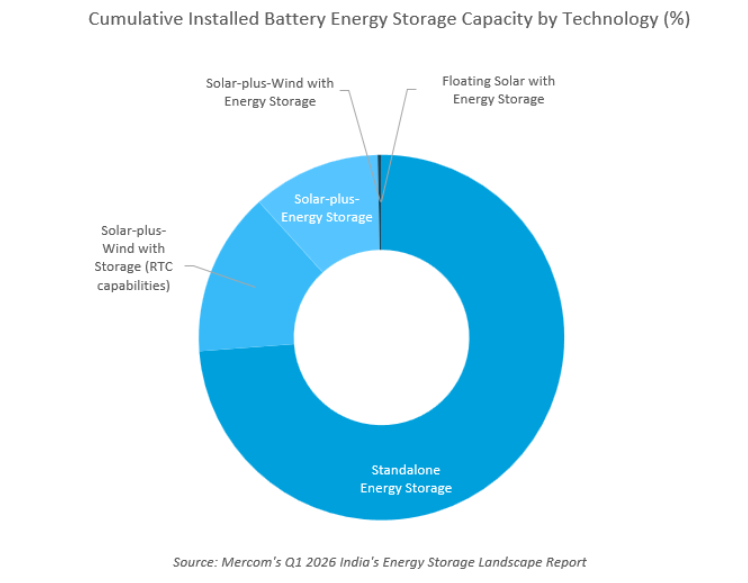
The pumped storage project (PSP) pipeline remained strong, with 57.2 GW of projects in various stages of development. Out of 7.2 GW installed, 5.7 GW of PSPs were operational as of March 2026.
“The strong growth in Q1 2026, coupled with a rapidly expanding project pipeline, reflects how quickly energy storage is becoming a core part of India’s power infrastructure. Policy support, including the expansion of the viability gap funding (VGF) program and mandatory storage requirements for new solar projects, has accelerated market development and strengthened the sector’s long-term outlook,” said Raj Prabhu, CEO of Mercom Capital Group.
“The next challenge is ensuring sustainable growth through realistic bidding, regulatory certainty, and policies that recognize storage as a strategic grid asset,” Prabhu added. “As renewable energy penetration increases, storage will play a critical role in maintaining grid reliability and supporting the integration of large volumes of solar and wind.”
According to the report, in Q1 2026, India’s energy storage development pipeline reached 69 GWh, comprising 41 GWh of standalone storage, 11 GWh of solar-plus-wind with storage, 9 GWh of solar-plus-energy storage, and 1 GWh of solar-plus-wind with storage projects (RTC capabilities). Additionally, there were 6 GWh of renewable energy-plus-storage projects, with unspecified configurations for both renewable and storage.
Gujarat had the largest pipeline of standalone battery storage capacity at 10 GWh.
This content is protected by copyright and may not be reused. If you want to cooperate with us and would like to reuse some of our content, please contact: [email protected].

Please login to comment