Advait outlines strategy for integrated capabilities from tech and manufacturing to asset ownership

Advait Energy Transitions has outlined a shift in its long-term strategy, focusing on building capabilities that integrate technology, manufacturing, and engineering, procurement, and construction (EPC) execution. The company is also selectively evaluating opportunities to develop and own energy assets.
The company management said that such investments will be assessed on their technical, commercial, and financial merits, with an emphasis on sustainable cash flows, prudent capital allocation, and long-term performance.
Addressing shareholders at the AGM, Shalin Sheth, Founder & Managing Director, Advait Energy Transitions Ltd, said, “FY26 was a year of strong execution and an important evolution in Advait Energy’s long-term strategy. We have built this Company by recognizing opportunities early, developing technical capability patiently and executing with discipline.”
He further highlighted the importance of combining capabilities across the energy value chain. Advait’s manufacturing operations provide experience across products, quality, performance, supply chains and technology, while its EPC operations add engineering, project management and commissioning capabilities. The company believes this integrated approach can strengthen its participation across manufacturing, technology, project execution and, selectively, energy asset ownership.
FY26 marks major milestones
FY2025-26 saw Advait’s consolidated revenue from operations grow 79.68% year-on-year to INR 714.52 crore, while the company closed the year with an order book of approximately INR 1,304 crore, up 159% year-on-year, supported by an active tender pipeline of around INR 2,000 crore.
The company reported consolidated profit after tax of INR 58.08 crore, up 75%.
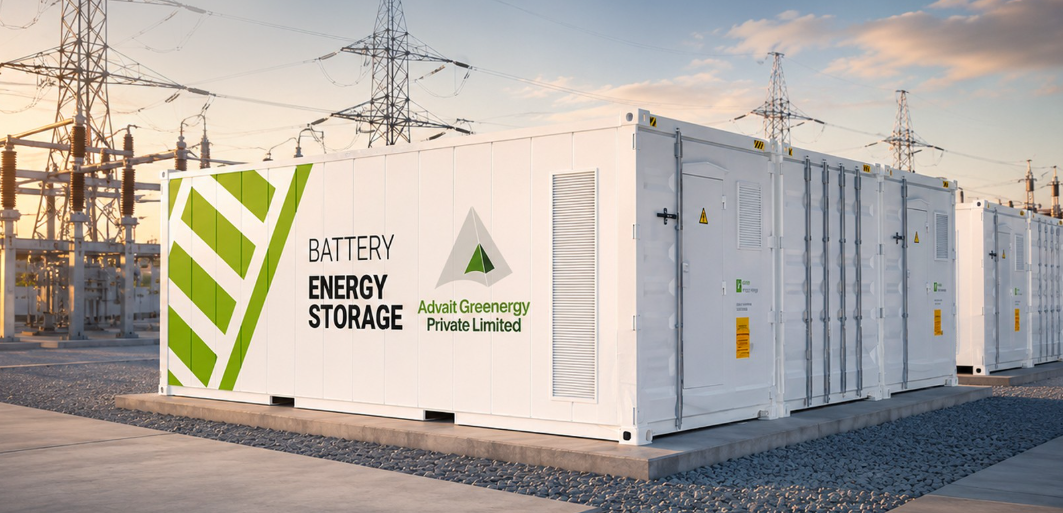
In FY 2026, Advait demonstrated strong operational progress across its clean energy portfolio. Advait Greenergy Private Ltd, a material subsidiary focused on renewable solutions, initiated work on its initial 50 MW/100 MWh battery energy storage system contract for Gujarat Urja Vikas Nigam Ltd under a 12-year build-own-operate framework. This marked the Group’s entry into long-duration energy storage assets, which was complemented later in the period by securing a 150 MW/300 MWh BESS project in Junagadh alongside ongoing installations in Radhanpur.
Concurrently, the company commissioned phase one of its alkaline electrolyser assembly plant in Mehsana, Gujarat, establishing an initial 30 MW capacity. Management plans to expand this through a 100 MW second phase toward a target 300 MW integrated hydrogen manufacturing hub. Additionally, a 1 MW green hydrogen facility was completed in Gujarat, and a 67.5 MW ground-mounted solar asset was commissioned under the IPP model in Khavda. The business also became the first domestic firm to demonstrate live testing of a 5 MW electrolyser with verified Specific Energy Consumption metrics.
Progress continued on the company’s integrated manufacturing hub, designed to combine specialized conductors, battery storage, electrolyser, and fuel cell manufacturing. The Gangad facility’s planned annual capacity includes 12,000 circuit kilometers of specialized conductors, 2.5 GWh of BESS assembly, and 300 MW of electrolyser production.
This content is protected by copyright and may not be reused. If you want to cooperate with us and would like to reuse some of our content, please contact: [email protected].

Please login to comment
Thank you for sharing such insightful content on Advait’s strategic approach! I appreciate how you highlighted the integration of technology and manufacturing with asset ownership, which seems crucial for driving innovation in the energy sector. Could you elaborate on any specific challenges they foresee in implementing this strategy? fnaf 2