Indian battery component makers face up to 61% cost disadvantage against Chinese benchmarks, study finds

Indian manufacturers of advanced chemistry cell (ACC) battery components face a cost disadvantage of 18% to 61% compared with landed Chinese benchmark prices, depending on the component, according to a study released by the Ministry of Heavy Industries. The assessment covers cathode active materials (CAM), anode active materials (AAM), electrolytes, separators and copper foil, with the highest cost disadvantage recorded for synthetic graphite anodes and the lowest for nickel manganese cobalt (NMC) cathode materials.
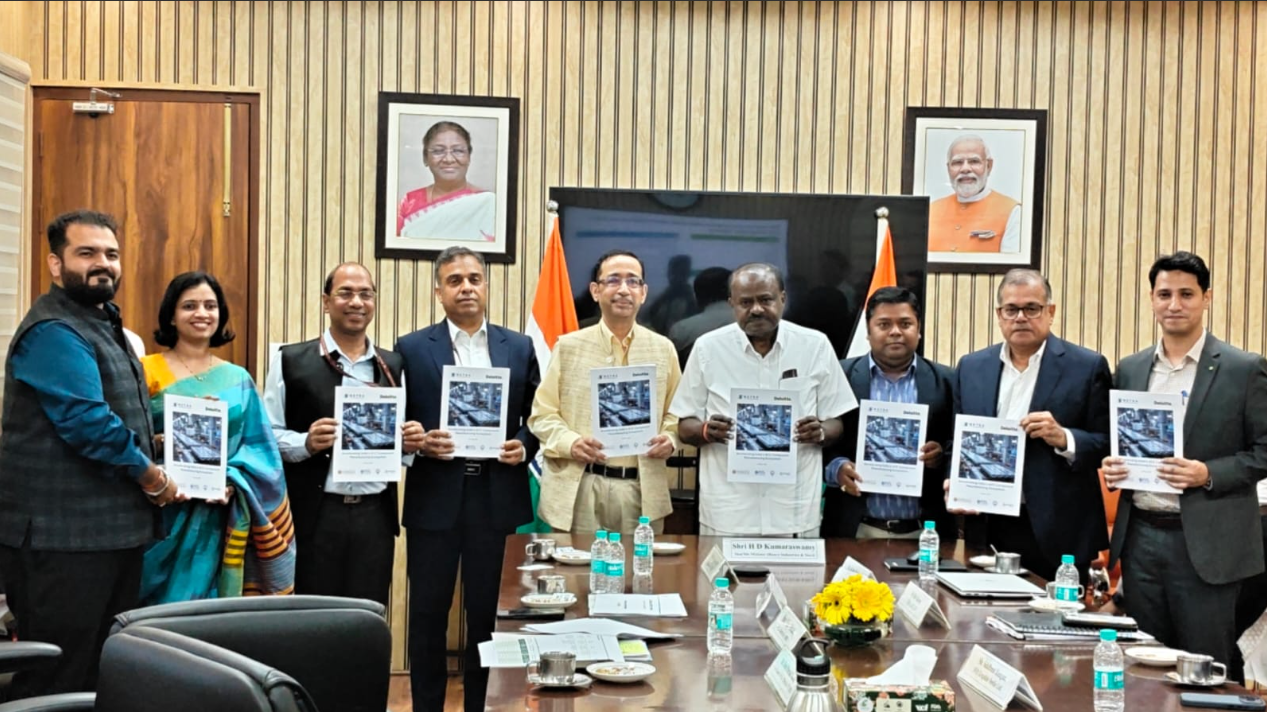
The report, prepared by Net-Zero Energy Transition Association (NETRA), in collaboration with ARCI, CSIR-NCL, IIT Madras, and Deloitte, was launched by the Ministry of Heavy Industries. It comes as the government considers a targeted support scheme for battery component makers.
The study, “Accelerating India’s ACC Component Manufacturing Ecosystem,” points to China’s near-total dominance in global battery component supplies. In 2025, China accounted for 99% of LFP cathode material, 90% of anode material, 93% of electrolyte, 85% of separators, and 74% of copper foil, as per JP Morgan and Nomura data.
“The cost data in this report comes from Indian companies that are building or planning these plants, and it shows that the gap has a different cause in each component,” said Debi Prasad Dash, Co-Founder and Executive Director, NETRA. “A flat incentive would overpay some producers and underpay others. So we have given the Government component-wise rates under three options, and each one leaves manufacturers carrying a meaningful share of the gap.”
The report finds that cost gaps for Indian producers have distinct causes for each component. For cathode materials, electrolytes, and copper foil, high raw material prices are the main factor. For graphite anodes, conversion and energy costs, depreciation, and financing add to the burden. In the case of separators, high capital intensity, imported technology, and low early utilisation rates are the primary challenges.
The report estimates that capital expenditure for cathode active material manufacturing in India is 235% higher than in China, while the CAPEX differential for anode active material manufacturing is 425%.
Borrowing rates are 8.5% to 16% in India, compared to about 3.1% in China. New suppliers must wait 18 to 24 months for qualification by cell makers, often leaving new plants underused in their initial years.
“Energy storage is becoming critical everywhere, from the grid to electric vehicles to the appliances in our homes. Staying in that game depends on processing materials to battery grade, holding quality to the micron and building our own R&D, not only on building cell factories. What people don’t realise is how long that capability takes to build,” said Dr Rahul Walawalkar, Founder and President, NETRA. “New entrants face high scrap rates for five to six years, and cell makers take 18 to 24 months to qualify a supplier. Decisions taken by March 2027 will decide whether the cell plants coming online by March 2029 can buy qualified materials made in India. We offer this evidence with options, not a single demand.”
ACC components account for approximately 76% of total battery cell manufacturing costs. Cathode and anode materials account for approximately 34% and 25%, respectively, with electrolytes and separators making up much of the remaining component costs.
India’s battery demand is projected to jump from about 33 GWh in 2025 to 236 GWh in 2032 and close to 600 GWh by 2037. Yet, current Indian capacity covers less than 3% of the cathode, anode, and electrolyte requirements projected for 2032, and there is no known domestic production of separators or battery-grade copper foil.
To close the cost and capacity gaps, the report proposes three incentive options for the government: a 25% capital subsidy plus a sales-linked operating incentive offsetting about 30% of each component’s cost gap (incentive ranging from 5% to 18% by component); an operating incentive alone, covering about 60% of the gap (11% to 37% by component) for five to seven years; or a 50% capital subsidy released alongside the investor’s own spending, as in the Semicon India programme. Each option is structured so that manufacturers still bear a meaningful share of the gap, encouraging efficiency and cost control.
The report also recommends building a national network for component testing, certification, and qualification using existing laboratories, launching a programme for domestic battery-grade raw material processing, supporting local manufacture of specialised plant and machinery, and creating integrated battery-material clusters. It points out that the Electronics Component Manufacturing Scheme currently supports these components only for digital device batteries, even though electric mobility and grid storage are expected to make up over 90% of India’s future demand.
This content is protected by copyright and may not be reused. If you want to cooperate with us and would like to reuse some of our content, please contact: [email protected].

Please login to comment