MIT-WPU researchers develop solar thermal battery for hot water supply after sunset

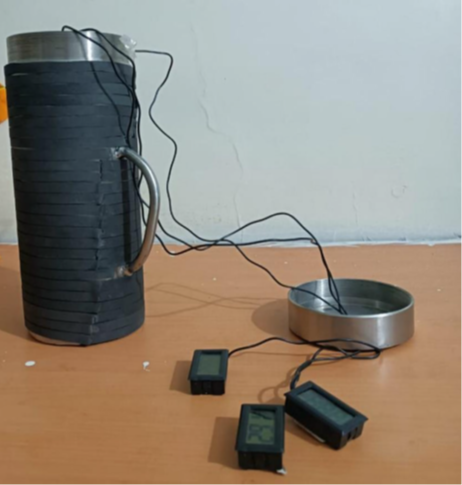
Researchers at MIT World Peace University (MIT-WPU) have developed a solar thermal energy storage system that enables hot water availability even after sunset by storing solar heat in a phase change material (PCM)-based thermal battery. The technology addresses one of the biggest challenges associated with solar energy—its intermittent availability—and has the potential to reduce dependence on electricity and fossil fuels for water heating applications.
Developed by Anita Nene and Rohit Ghadge from the Department of Mechanical Engineering, MIT-WPU, the system combines a Scheffler solar concentrator with a thermal storage capsule containing paraffin wax, a phase change material capable of storing and releasing large amounts of heat.
Unlike conventional energy storage systems that rely on electrochemical batteries, the proposed solution stores energy directly as heat. The system incorporates a detachable PCM tube, a water-jacket heat transfer mechanism, and polyurethane insulation to maximize heat retention and energy utilization.
According to the researchers, the technology achieved complete thermal charging in around 18 minutes and complete discharge in around 32 minutes during laboratory-scale testing. The system continued supplying hot water after solar input was removed, demonstrating its ability to provide thermal energy beyond daylight hours.
The prototype stores around 1.5 to 2 kWh of thermal energy and can maintain water temperatures between 50°C and 60°C for up to 14 hours after charging.
“One of the major limitations of solar energy is that it is available only when the sun is shining. Our objective was to develop a simple, cost-effective, and sustainable thermal storage solution that can store solar energy and make it available whenever required,” said Anita Nene.
“Thermal energy accounts for a substantial share of overall energy consumption. Technologies that enable efficient storage of solar heat can help reduce dependence on conventional fuels, improve energy security, and support the transition towards cleaner and more sustainable energy systems,” said Rohit Ghadge.
The researchers conducted Computational Fluid Dynamics (CFD) simulations alongside laboratory-scale validation to evaluate system performance.
The system has demonstrated 55% thermal efficiency and has reached Technology Readiness Level (TRL) 7, with pilot deployments being planned.
Potential applications include residential water heating systems, hotels, hospitals, hostels, educational institutions, industrial process heating facilities, community kitchens, agricultural operations, and off-grid rural communities.
An Indian patent application titled “Solar Energy Storage Capsule Using Phase Change Material” has been filed under Application No. 202521118546. The researchers are currently exploring collaborations with industry partners for pilot deployment and commercialization.
“The next phase of development will focus on field trials, performance optimization, and scale-up for commercial deployment,” said Anita Nene.
This content is protected by copyright and may not be reused. If you want to cooperate with us and would like to reuse some of our content, please contact: [email protected].

Please login to comment