Scheduling discipline at a judicial crossroads: India’s evolving deviation settlement mechanism

India’s renewable energy build-out has been one of the defining infrastructure stories of the last decade. Wind and solar, once marginal contributors, now account for a substantial share of installed capacity, and the Government has set a target of 500 GW of non-fossil capacity by 2030.
This growth, however, has exposed a structural mismatch between the regulatory architecture governing dispatch and the physical characteristics of the resources now dominating the generation mix:
1. The scheduling and dispatch framework was designed around conventional thermal generation, which is dispatchable on demand, and
2. The grid is now substantially supplied by variable renewable energy, whose output is weather-dependent and inherently non-dispatchable, thereby exposing the limits of that legacy framework.
Against this backdrop, the Deviation Settlement Mechanism (“DSM”), introduced in 2014, has emerged as the principal regulatory tool for enforcing scheduling discipline across the Indian grid. The DSM operates on a simple yet powerful principle: when the system frequency falls below the reference value of 50 Hz, generators that under-inject power are penalised, whereas when the frequency rises above 50 Hz, generators that over-inject are charged. The mechanism is designed to internalise the cost of imbalance by making the responsible entity pay, rather than socialising those costs across the grid. In doing so, it seeks to align private behaviour with the imperatives of grid stability.
Now, two interconnected developments (DSM Regulations, 2024, and Order in Petition No. 9/SM/2025 – discussed below) have materially reshaped the landscape. Together, they signal a fundamental shift from institutional tolerance for renewable variability to an expectation of progressive grid-scheduling accountability.
The DSM Regulations, 2024: A substantive overhaul
The Central Electricity Regulatory Commission (“CERC” or “Commission”) notified the CERC (Deviation Settlement Mechanism and Related Matters) Regulations, 2024 (“DSM Regulations, 2024”) on August 5, 2024, the most substantive overhaul since its inception. The key structural changes for WS Sellers (i.e., Wind and Solar generators) are:
(i) Revised deviation formula:

From April 1, 2026, the denominator for computing deviations shifts from Available Capacity (“AvC”) to a weighted blend of AvC and Scheduled Generation (“SG”), governed by a factor “X” set by the Commission after consultation. As X falls, the financial penalty for the same deviation grows.
(ii) Tighter tolerance bands: From April 1, 2026, the revenue-neutral (penalty-free) deviation band narrows from ±10% to ±5% for solar/hybrid stations and from ±15% to ±10% for wind.
(iii) Aggregation through QCAs: Qualified Coordinating Agencies (“QCAs”) are strengthened, allowing WS Sellers to pool output at the station level, which is the Commission’s primary tool for softening the impact on developers.
The X-factor order: CERC’s calibrated transition
The DSM Regulations 2024 deliberately left the specific values of “X” to be fixed later, through consultation. That exercise concluded with the Order in Petition No. 9/SM/2025 (Suo-Motu) dated March 31, 2026. The Commission gathered views from 46 (forty-six) stakeholders across the industry before making its decision.
Its decision rested on two straightforward arguments:
(i) Grid data: On July 29, 2025, renewables supplied a record 51.5% of India’s daily electricity. On May 25, 2025, the system frequency remained above 50.05 Hz for roughly 30% of solar hours, largely due to unscheduled over-injection by RE plants. These imbalance costs fall on consumers.
(ii) No excuse for ignorance: Forecasting and scheduling rules for RE generators have been in place since 2015. Tamil Nadu moved to a schedule-based formula on April 1, 2024. Further, the draft National Electricity Policy (January 2026) aims to achieve scheduling parity between RE and conventional generators by 2030.
The Commission agreed to the industry’s request to treat wind and solar differently, as wind is inherently harder to forecast. The approved reduction path for “X” is set out below:
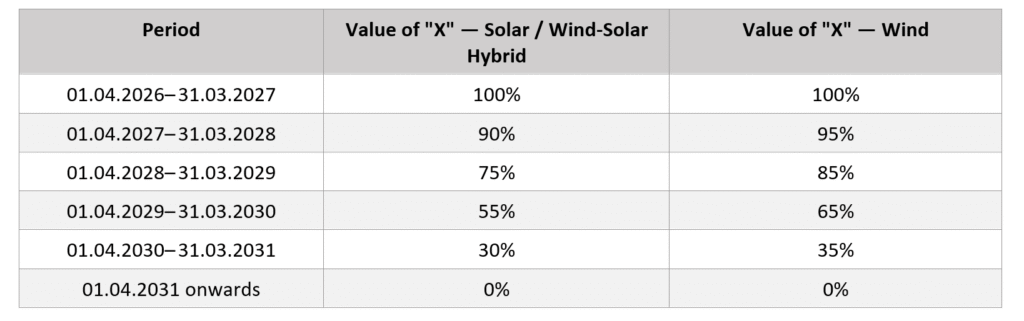
In plain terms, no developer faces a change in FY 2026–27. The tightening begins in FY 2027–28 and reaches zero (full parity with conventional generators) by FY 2031–32. The Commission described the outcome as “not punitive in character but a calibrated regulatory tool designed to balance renewable integration.”
The industry’s concerns: Real risks, contested remedies
The industry’s objections are not abstract. Three significant concerns stand out:
(i) Revenue erosion: For a wind project charging INR 2.80/kWh, current deviation losses are about 2.8%, resulting in an effective tariff of INR 2.72/kWh. Under X = 0, losses could reach 20%, requiring tariffs of around INR 3.30/kWh to remain viable. That gap directly increases procurement costs for distribution companies and large industrial and commercial consumers.
(ii) Change in law: Existing and under-construction projects were bid and financed on the old AvC-based formula. Applying the revised formula to them was widely characterised as a change in law, as the one that could not have been priced in at the time of bidding and cannot now be renegotiated. The Commission’s response, that the change was signalled in August 2024, did not satisfy developers who had committed capital years earlier.
(iii) Must-run asymmetry: The Commission also proposed zero payment for over-injection when the grid frequency is at or above 50.05 Hz, while full deviation charges continue for under-injection. Developers and large consumers alike objected that this conflicts with renewable energy’s must-run status and that penalising generators for conditions driven by curtailment decisions, in the absence of real-time State Load Dispatch Centre/Regional Load Dispatch Centre visibility, is fundamentally unfair.
A framework under judicial scrutiny
Both the regulatory and commercial uncertainties have now reached the courts. Two Hon’ble High Courts have intervened, and their orders directly affect how and whether the revised framework currently operates.
Delhi High Court: Vide interim order dated November 20, 2024, the Hon’ble Court directed that no coercive action be taken against petitioners who challenged the DSM Regulations, 2024. The CERC incorporated this into its March 2026 Order, making its own directions subject to the continuance of that restraint.
Karnataka High Court: Vide order dated April 27, 2026, the Hon’ble Court granted an interim stay on Regulations 6(2)(b) and 8(4) of the DSM Regulations 2024 (i.e., the revised formula and the tightened bands) in favour of the petitioners. The Hon’ble Court found a prima facie case that the revised formula, absent from the draft Regulations circulated for stakeholder feedback, was introduced without a genuine opportunity to respond. This violated Section 178(3) of the Electricity Act, 2003, which requires prior publication. Relying on the Supreme Court’s decision in Ramakrishna Vivekananda Mission v. State of West Bengal, the Hon’ble Court directed the petitioners to continue under the pre-2024 DSM regime and to pay deviation charges, including for deviations up to 15%. The matter returns on June 10, 2026.
What remains unresolved?
The Commission’s March 2026 Order also flagged three further proposals that require separate regulatory amendment before they can take effect:
(i) Aligning all existing WS Sellers with the General Seller framework from April 1, 2031.
(ii) Immediately treating new WS projects (tendered on or after April 1, 2026) as General Sellers from day one.
(iii) Paying zero for over-injection when the system frequency is at or above 50.05 Hz.
None of these is law yet. Each proposal requires a fresh consultation process. The Ministry of New and Renewable Energy has acknowledged that DSM penalties, curtailment, and transmission delays are ‘under active consideration, with efforts underway to arrive at balanced and practical solutions.’ That is a welcome signal. But until the Delhi and Karnataka High Court challenges are resolved, the operative effect of the DSM Regulations, 2024, remains as much a function of the judicial calendar as of regulatory design.
The direction of regulatory travel is clear and, in principle, correct: a grid carrying 500 GW of renewables cannot operate under scheduling assumptions designed for a marginal share of renewables. But accountability imposed without adequate forecasting infrastructure, procedural fairness, and transition protection for existing projects risks undermining the very investment climate it depends upon. The question is no longer whether India will move to a schedule-based regime, but on what terms it will do so. Those terms will define the bankability of the country’s renewable energy sector for the decade ahead.
The views and opinions expressed in this article are the author’s own, and do not necessarily reflect those held by pv magazine.
This content is protected by copyright and may not be reused. If you want to cooperate with us and would like to reuse some of our content, please contact: [email protected].
Please login to comment